The Windows of Your Soul: How Heaven Reaches Earth


The Geography We Got Wrong

Picture a typical Sunday school image: God sits somewhere high above the clouds, remote and difficult to reach, while we stand below on solid ground, hoping He notices our prayers. We imagine the sky as a ceiling separating us from Him—millions of miles of empty space between heaven and earth.

This image has shaped how we understand Scripture. When we read Malachi's promise that God will "throw open the floodgates of heaven and pour out so much blessing that you cannot contain it," we naturally picture literal gates cracking open in the atmosphere, divine blessing cascading down from the stratosphere.

But what if we've been looking in the wrong direction?

The Bible reveals a radically different geography—one that's far more intimate and, frankly, more powerful. The boundary between heaven and earth isn't millions of miles away in the sky.

It's inside you.

The Three Layers of You

The apostle Paul describes human beings as existing in three distinct parts (1 Thessalonians 5:23): spirit, soul, and body. Understanding this blueprint changes everything.

Think of it this way:

* Your Spirit = the part of you that exists in heaven's reality  
* Your Soul = the window connecting the two worlds  
* Your Body = the part anchored here on earth

Picture these three layers stacked on top of each other, with your soul sitting right in the middle:

        SPIRIT REALM
    (Your Spirit - in Heaven)
           ══════
      THE SOUL (The Window)
    Mind • Will • Emotions
           ══════
      PHYSICAL REALM
  (Your Body - on Earth)

Layer 1: Your Spirit (Already in Heaven)

Here's where most people's minds break. Paul writes something that sounds almost too good to be true: God has already "raised us up with Christ and seated us with him in the heavenly realms" (Ephesians 2:6).

This isn't poetry. This isn't symbolic. Your born-again spirit is currently seated in God's presence—not someday, but now. In your spirit, you lack nothing. There is no sickness there, no fear, no exhaustion, no scarcity. Your spirit exists in a realm of complete abundance, continuously immersed in everything God provides.

Layer 2: Your Body (Anchored Here)

Your physical body is something else entirely. Made from the dust of the earth (Genesis 2:7), it operates under the constraints of time, gravity, and material limitation. It's bound by physical laws. It tires. It ages. It experiences lack.

This is your earthly container, and it's very real.

Layer 3: Your Soul (The Window That Changes Everything)

Your soul is where the magic happens. It's your consciousness, your thoughts, your emotional life, your decisions. It's the interface between your heavenly spirit and your earthly body.

And here's the crucial insight: your soul acts as a window pane.

When that window is clear and open, the infinite supply of peace, wisdom, and provision already in your spirit flows freely into your physical life. Your circumstances begin to shift. Your mind settles. Your body heals.

But when the window is smudged, painted over, or blocked? The light of heaven shines just as brightly on the other side—but you can't see it. You remain trapped in the logic of your five senses, reacting only to what the world tells you about your situation.

Why Your Mind Feels So Heavy

This is where Romans 12:2 suddenly makes perfect sense:

"Do not conform to the pattern of this world, but be transformed by the renewing of your mind. Then you will be able to test and approve what God's will is—his good, pleasing and perfect will."

The word "transformed" here is metamorphoo—the root of metamorphosis. But here's what it doesn't mean: it's not about becoming something entirely new or pretending to be someone you're not.

It means letting what's already true on the inside show up on the outside.

The light is already blazing in your spirit. The abundance is already there. The problem is that the window pane—your mind—is heavily smudged.

That grime comes from years of:

* Worldly conditioning (society telling you who to be)  
* Survival instincts (fear-based thinking from childhood)  
* Personal wounds (trauma that left marks)  
* Inherited lies (beliefs you absorbed without questioning)

Fear works like thick dust on the glass. Bitterness warps the pane like heat damage. Anxiety paints it black. Meanwhile, the light on the other side keeps shining—constant, abundant, perfect. But it can't reach you because you can't see through.

"Renewing your mind" isn't trying to convince a distant God to help. It's the active, steady process of cleaning the window.

As you align your thinking with truth, release old wounds, and let prayer reshape your perspective, you're not generating light. You're removing what's blocking it. As the glass gets clearer, the light flows through effortlessly into your physical body, your decisions, your health, and the world around you.

The Original Lie That Changed Everything

Trace every spiritual problem back far enough, and you'll find the same root cause: Eden.

Satan didn't convince humanity that God doesn't exist. He convinced them that God cannot be trusted.

The serpent leaned close to Eve and whispered something lethal: "God is holding out on you. He doesn't have your best interest at heart. He's keeping the good stuff for Himself."

That single lie became the first smudge on the human soul. And it's never stopped spreading.

Every time you:

* Hoard because you don't trust provision will come  
* Control because you're afraid of being let down  
* Resist surrender because you fear what God might ask  
* Work frantically because you think God won't come through

...you're living out that original suspicion: If I give God control, He might demand everything and leave me with nothing.

This is precisely why Paul finishes Romans 12:2 the way he does. Notice: the renewed mind doesn't just feel better. It actually knows something it didn't know before. It discovers that God's will is "good, pleasing, and perfect."

When your mind is smudged by the world's fear-logic, God's will looks terrifying—like restriction, loss, or control. But the moment the window clears, the light floods through, and you see God for what He actually is.

His intentions toward you were never restrictive. They were protective, generous, and overwhelmingly good.

The fear that God will withhold vanishes when you realize He's already placed infinite spiritual abundance in your spirit. He's waiting for one thing: an open window through which to pour it out.

The Law of Overflow

When this mechanism actually works, Malachi 3:10 stops being a dusty verse and becomes a law of spiritual physics:

"Open the floodgates of heaven... pour out so much blessing that there will not be room enough to store it."

Think about what that promises. Your earthly container—your time, your energy, your individual capacity—is finite. You only have 24 hours a day. You only have so much physical energy. There's only so much you can hold.

But the supply in your spirit is infinite.

When a clear soul allows infinite supply to pour into a finite vessel, something has to give. The vessel overflows.

This isn't God's design for you to be a vault—hoarding peace and provision behind locked doors. God designed the window of your soul to open such an overwhelming deluge of His goodness that your personal container bursts.

The spillover becomes the vehicle that nourishes your family, revives your workplace, heals your community, and transforms your world.

What This Means Today

You don't need to construct a ladder to climb up to heaven. You don't need to scream at the sky or perform desperate rituals to pull God down to earth.

You simply need to take up the cloth of truth.

Wipe clean the window of your mind. Identify the lies you've believed about God's character. Release the wounds that built the grime. Choose, day by day, to align your thoughts with what Scripture actually says about God.

And as the glass clears—slowly, steadily, sometimes painfully—watch what happens.

The heaven that already resides within your spirit will shine unfiltered into your world. The blessing won't just touch your own life. It will overflow into everyone around you.

That's not poetry. That's the physics of how spiritual reality actually works.

The window is waiting. The light is already shining.

All that's left is to start cleaning.

The Grace-and-Effort Paradox:

How “Diligently Seek” Doesn’t Contradict “All Grace”

You’ve probably felt this tension yourself.

You’re reading through Hebrews, and you hit verse 11:6: *”God is a rewarder of them who diligently seek Him.”* And your mind does a double-take. Because everywhere else in Scripture, you’re hearing: *”It’s all grace. You can’t earn it. You can’t work for it. It’s the free gift of God.”*

So which is it? Do we have to *work* for God’s favor, or is it freely given?

This isn’t a small question. It’s the difference between a God who’s constantly tracking our effort and a God who meets us in our seeking with open arms. No wonder so many people feel spiritually exhausted—they’re trying to reconcile two Scripture passages that *sound* like they’re contradicting each other.

But here’s the thing: they’re not contradicting. They’re completing each other. And understanding how requires us to make a distinction that most modern readers completely miss.

The Real Question You’re Actually Asking

Before we go further, let’s be honest about what bothers us. When we read “diligently seek,” what we hear is *work*. Labor. Effort. The sweat of your own brow. And if God’s grace means we don’t have to earn anything, then “diligently seeking” sounds like… well, earning.

But here’s where we’ve misunderstood the real problem.

The issue isn’t just “grace vs. effort.” The deeper issue is **self-sufficiency vs. desperation**.

Because there’s a kind of seeking that’s actually just another form of self-reliance. There’s a way to “diligently seek” that’s rooted not in weakness, but in confidence that *you* can figure this out, *you* can reach God through enough effort, *you* can solve your own spiritual problems if you just try hard enough.

And that’s precisely what God opposes.

The Bible is clear: God uses the weak to confound the strong. He resists the proud but gives grace to the humble. And here’s the kicker—when we’re working and trying to do it ourselves, God *steps back*. But when we finally rest in our own inadequacy, God *moves in*.

So which passage wins? Does Scripture contradict itself?

No. But we’ve been asking the wrong question. The real question isn’t “Does grace work with effort?” It’s “What kind of seeking positions us to receive grace—the kind rooted in self-sufficiency, or the kind rooted in desperation?”

The Distinction That Changes Everything

Here’s what theologians have understood for centuries, and what Dallas Willard captured perfectly in one sentence:

**Grace is not the opposite of effort. Grace is the opposite of earning.**

But we need to go deeper. Because effort itself can become a form of self-sufficiency—a way of saying, “I’ve got this. I can handle it. I just need to work harder.”

The real distinction Scripture is making isn’t effort vs. no effort. It’s this:

**When we’re trying to do it ourselves, God rests.**

**When we rest in our weakness, God works.**

That’s the principle woven through Scripture. That’s what “diligent seeking” actually means. It’s not the strength of your striving. It’s the honesty of your *need*.

Think about the difference between these two kinds of seeking:

**Self-Sufficient Seeking** = “I’m going to figure this out. I’m going to discipline myself into righteousness. I’m going to work hard enough to be acceptable to God. If I just try harder, pursue more intensely, pray longer, I can make this happen.”

This kind of seeking? It keeps God at arm’s length. Because it’s rooted in the belief that *you* can do it. That your effort is the solution.

**Desperate Seeking** = “I’m broken. I can’t fix myself. I’ve tried everything and nothing works. I’m at the end of myself, and I’m throwing myself on God’s mercy. I’m seeking Him not because I think I can force Him to help, but because I’ve finally admitted I can’t help myself.”

This kind of seeking? This is where grace rushes in. Because finally, *you’re not in the way anymore*. Your self-sufficiency, your confidence that you can manage this on your own—that’s what was blocking God. The moment you stop working to save yourself and start resting in the reality that you *can’t*, God has the space to work.

That’s the real opposition in Scripture. Not effort and grace. But self-reliance and helplessness.

A Billion Dollars Doesn’t Care How Far You Walk

Imagine this: Someone offers you a free, no-strings-attached, one-billion-dollar inheritance. The only condition? You have to walk across the room to sign the paperwork.

So you walk across the room. You’re sweating. You’re focused. You’re determined. You’re putting in *effort*.

Did your walk *earn* the billion dollars?

Of course not. You would walk across the room a million times over if that’s what it took to receive a billion-dollar gift. Your effort isn’t what generated the value. The gift was always there—free, waiting, unreserved. Your effort was just the medium through which you *accepted* it.

That’s the relationship between diligent seeking and grace.

When Hebrews tells you to diligently seek God, it’s not telling you to *earn* God’s favor. It’s telling you to *position yourself to receive* what God is already desperately eager to give you.

The effort positions you. The grace does the heavy lifting.

Why the Sailboat Metaphor Matters

Picture a sailboat in the middle of the ocean. The sailors on that boat are working *hard*. They’re pulling heavy ropes, adjusting the rigging, steering the wheel, staying awake through storms. It’s backbreaking, relentless effort.

But here’s the question: Did their effort create the wind?

No. A thousand times no.

If there’s no wind, all their work achieves nothing. They can pull ropes until their hands bleed. They can adjust the rigging until sunset. But without the wind, the boat doesn’t move.

The wind is doing something their muscles never could. The wind is the *power*. Their effort is just the *positioning*.

In the spiritual life:

– **The Wind is God’s Grace.** It’s the actual power that saves, that transforms, that draws you to Himself. It’s completely unearned. It’s outside your control. It’s the engine of everything.

– **The Sails are your Diligent Seeking.** Your effort in prayer, in reading Scripture, in honestly facing your need for Him—that’s setting your sails. You’re positioning yourself to *catch* the wind that’s already blowing.

When sailors arrive safely at their destination, they don’t stand on the dock beating their chests saying, “Look at the wind we *manufactured* with our muscles!” They recognize a truth: *Our effort was required to catch the gift, but the gift did the heavy lifting.*

That’s the principle. But there’s something else we need to understand about that sailboat.

The Inversion Principle: When We Work, God Rests

Here’s something Jesus said that most of us completely miss: *”Come to me, all you who are weary and burdened, and I will give you rest… For my yoke is easy and my burden is light.”*

Notice He’s not saying, “Work even harder.” He’s saying, “Stop working so hard and let me carry the load.”

And here’s the principle embedded in Scripture again and again: **When we’re working and striving to fix ourselves, God steps back. When we rest in our inability, God moves in.**

Think about Israel in the wilderness. Over and over, God tells them: “Stop trying. Sit still. Watch what I do.” And the moment they stop trying to save themselves and rest, God shows up with power—parting seas, providing manna, defending them in battle.

Or consider Peter sinking in the water. He’s got strength. He’s got willpower. He’s got effort. But the moment he’s sinking—the moment his own effort has failed—Jesus reaches out and catches him. Not because Peter finally tried hard enough. But because Peter finally *stopped* trying and admitted he was going down.

That’s the inversion. The strongest thing you can do is become weak enough to receive help.

This is why God uses the weak to confound the strong. Because strength—human effort, confidence in your own ability—actually *blocks* grace. We’re so busy trying to fix ourselves that we never give God room to move.

**When you’re exhausted from trying harder, that’s not a sign you should try harder still. It’s a sign you should finally rest and let God work.**

Self-sufficiency is the real enemy. Not effort—self-sufficiency dressed up as effort.

But Why Does God Demand Diligence at All?

This is the question that still nags at people: If God is truly gracious, why doesn’t He just hand out the reward without making us sweat for it?

Why not just *give* you a relationship with Him without requiring that you seek Him?

The answer reveals something profound about what grace actually *is*.

Grace isn’t just a handout. Grace is about *relationship*. And relationships require something from you—not because you’re earning anything, but because you’re *becoming someone capable of receiving it*.

C.S. Lewis understood this perfectly. He used the picture of a child asking their parent for help learning geometry.

The parent’s willingness to teach—the time, the patience, the tutoring—that’s pure grace. A gift of love. But here’s what the parent *cannot* do: The parent cannot just hand the child the knowledge without the child’s brain doing the heavy lifting. The grueling, frustrating hours of study aren’t punishment. They’re *transformation*. They’re the way the child’s mind becomes capable of understanding geometry.

Without that effort, the child’s brain simply isn’t developed enough to receive the knowledge.

The same is true spiritually.

When you diligently seek God—when you pray, when you wrestle with Scripture, when you honestly face your own brokenness—you’re not *earning* God’s presence. You’re *developing the spiritual capacity* to actually *enjoy and benefit from* His presence.

A person who has never sought God won’t know how to receive Him. A heart that’s never pursued Him won’t recognize Him when He shows up. Seeking *changes you*. It humbles you. It orients your desires toward Him. It creates the conditions in your soul where grace can actually *land* and take root.

The diligence isn’t the price you pay for the reward. It’s the *preparation* your heart needs to receive it.

Grace Initiates Everything—Even Your Seeking

Here’s another layer most people miss entirely:

You don’t even initiate your own seeking. Grace does.

The Bible is crystal clear on this: “No one understands; no one seeks for God” (Romans 3:11). Left to our own devices, left to our natural human inclinations, we don’t seek God. We run from Him. We hide from Him. We ignore Him.

So where does your desire to seek Him come from?

Grace.

And here’s the critical part: The only seeking that matters is the kind that begins with *admission of defeat*. The kind that starts when you finally stop trying to fix yourself and start looking for rescue.

Think of it like a person drowning. They can thrash around, fight the water, depend on their own swimming ability—and they’ll go under. But the moment they stop fighting, the moment they hold still and look for help, the lifeguard can do their work.

The seeking God rewards isn’t the desperate thrashing of someone trying to save themselves. It’s the kind of surrender where you finally stop trying and start looking for Him.

That’s why Scripture calls it “diligent seeking.” Not because you’re supposed to work *harder* and harder to earn something. But because you’re supposed to be absolutely *relentless* in your willingness to admit you need help. To keep coming back. To keep saying, “I can’t do this. I need You.” To refuse to go back to the lie that you’ve got this handled.

When you finally make that shift—when your seeking becomes less about trying and more about trusting—that’s when grace rushes in. Because now God isn’t dealing with someone trying to negotiate their way to righteousness. He’s dealing with someone who’s finally honest about their need.

Your desire to seek God? That’s already grace at work. Your willingness to stop relying on yourself? Grace. Your persistence in admitting you need Him? Grace undergirding you. The fact that when you stop trying and start looking, you find Him? That’s grace meeting you where you finally became available to be met.

So when you diligently seek God and find Him, you’re not a worker collecting wages. You’re a child responding to a parent’s call.

The Extravagant Disproportion

Here’s one more thing that reveals how this can never be about earning:

Look at what you’re asking for, and look at what you’re “working” for.

If this were an actual transaction—work for pay—the compensation would match the effort. You mow a lawn, you get paid for mowing a lawn. You work eight hours, you get eight hours’ worth of pay. There’s proportionality.

But what’s the “reward” for seeking God?

God Himself. Eternal life. Infinite joy. Cosmic adoption into His family. To know the Creator of the universe, face to face, forever. To have all your shame lifted, all your brokenness healed, all your longing finally satisfied.

No amount of seeking *could* be proportional to that reward.

You could spend your entire life seeking God, and you’d never come close to *earning* the reward. The reward is grotesquely, impossibly disproportionate to the effort.

That disproportion is the fingerprint of grace.

When a reward is earned, it matches the work. When a reward is grace, it *absurdly outweighs* the work. This isn’t even close. God isn’t paying you for your effort. He’s giving you everything out of a heart that’s bursting with generosity toward you.

Your seeking opens your hands. His grace fills them beyond overflowing.

How to Hold Both Truths

So here’s how grace and effort actually work together—not in contradiction, but in a kind of divine inversion:

**Grace initiates.** You don’t even want to seek God until His grace awakens that desire in you. You’re not capable of seeking until His grace empowers you. But notice—the grace that initiates isn’t rewarding your strength. It’s calling to your weakness. It’s the voice calling the drowning person to stop fighting and be rescued.

**You stop trying to save yourself.** This is the seeking. This is the “diligent” part. It’s not working harder. It’s working *less*—less striving, less self-reliance, less confidence that you can figure this out. It’s the relentless, desperate honesty that says, “I can’t. I’m broken. I need You.”

**Grace completes.** You don’t force God to show up. You can’t pay for your own sins with your effort. You can’t trade your diligence to put God in your debt. The moment you stop trying to be your own savior, He steps in as yours. He meets you, receives you, and rewards you not because you’ve finally done enough, but because you’ve *finally admitted you can’t* do enough, and He *promised* He would meet those who throw their hands up in surrender.

You’re not earning. You’re not working your way to heaven. You’re not accumulating points on a divine scoreboard.

You’re finally resting from the exhausting work of trying to fix yourself, and letting God do what only He can do.

The principle is simple: **When we stop working, God starts working. When we rest in our weakness, grace surges forward.**

The Freedom This Brings

When you finally grasp this—when you see that the real enemy is self-sufficiency, not effort—something shifts in your soul.

You don’t have to keep trying to fix yourself. You don’t have to wonder if you’re doing enough, being disciplined enough, seeking hard *enough*. You don’t have to exhaust yourself with the futile project of earning God’s approval through relentless self-improvement.

You can finally rest.

Because your sufficiency was never the point. Your weakness is. God opposes the proud but gives grace to the humble. And the moment you stop pretending you’ve got this handled and start admitting you don’t, God moves in with power.

*”He is a rewarder of them who diligently seek Him.”* But notice—the seeking that triggers the reward isn’t desperate striving. It’s desperate *honesty*. It’s the relentless, humbling admission: “I can’t do this. I need You.”

That’s when grace isn’t just available—it’s unstoppable.

Your self-sufficiency was the only thing keeping you from receiving what God had already set aside for you. The moment you stop working to save yourself and start resting in the fact that you *can’t*—that’s when everything changes.

The strong get weaker. The proud get humbled. The self-reliant finally admit they’re not.

And that’s when God shows up with an extravagance of grace that shatters every contract, exceeds every wage, and overwhelms every human calculation.

That’s the promise. That’s the paradox resolved.

And that’s what it means to live in grace by finally, mercifully, stopping the exhausting work of trying to be your own savior.

Rest from your labor. Let God do His work. That’s not laziness. That’s faith.

That’s grace in its purest form.

The Container and the Floodgate:

Why You Aren’t Lacking Blessing, You’re Lacking Capacity

We read Malachi 3:10 and picture God cracking open the windows of heaven, pouring out a blessing so massive there won’t be room enough to hold it.

Then we look at our own lives and think: “Okay, God. I’m trusting You. I’m doing my part. So where is it?”

Read the verse again, slowly. It doesn’t say God will run out of supply. It says we will run out of room. The floodgates aren’t stuck—they’re already open. The problem was never the size of the downpour. It’s the size of our bucket.

That’s the paradigm shift: We don’t pray to change God’s mind about blessing us. We pray to expand our capacity to hold what He’s already given.

The Reservoir Is Already Full

A lot of us live with slot-machine theology—drop in a coin of obedience, pull the lever, hope for a payout. Paul demolishes that idea in Ephesians:

“Blessed be the God and Father of our Lord Jesus Christ, who has blessed us with all spiritual blessings in heavenly places in Christ.” (Ephesians 1:3)

Notice the tense. Not will bless. Not is considering it. Has blessed. Past tense. Finished. In the spirit realm, your account isn’t pending approval—it’s already funded. Every bit of wisdom, peace, breakthrough, and resource you’ll ever need was signed and sealed in Christ before you ever asked.

So why does earth feel like a drought when heaven is reporting a flood? Because a spiritual reality has to travel through a pipeline to become a lived experience—and most of our pipelines are the width of a straw.

As Much As They Would

Picture the hillside in Galilee. Five thousand men, plus women and children, sitting in the grass, stomachs growling. Jesus holds up five loaves and two fish—a comically small container for that much need.

But watch what John notices, almost in passing:

“And Jesus took the loaves; and when he had given thanks, he distributed to the disciples, and the disciples to them that were set down; and likewise of the fishes as much as they would.” (John 6:11)

As much as they would.

The bread didn’t stop multiplying because Jesus got tired or heaven ran low. It stopped when people said, “I’m full. No more.” The only ceiling on the miracle was the size of the appetite and the reach of the hands holding baskets. Show up with a bigger basket, and there was more bread waiting for it.

God doesn’t force a gallon of glory into a pint-sized life. He doesn’t stop pouring—we stop providing something to catch it in.

According to the Power That Works in You

So how do we actually enlarge the container? Paul hands us the key at the end of Ephesians 3:

“Now unto him that is able to do exceeding abundantly above all that we ask or think, according to the power that worketh in us.” (Ephesians 3:20)

We love the first half—exceeding abundantly above. We rarely sit with the second half: according to the power that works in us.

The ceiling on God’s “abundantly above” isn’t set by His ability. It’s set by your internal capacity—your faith, your obedience, your understanding of who you actually are. The word for power here, dunamis, means inherent ability, force, capability. What shows up on the outside will always be proportional to what’s been built on the inside.

How You Actually Expand the Container: Renew Your Mind

Here’s the part most of us skip past: the primary tool for expanding your capacity isn’t more striving—it’s thinking differently about who you already are. Paul says it plainly:

“And be not conformed to this world: but be ye transformed by the renewing of your mind, that ye may prove what is that good, and acceptable, and perfect, will of God.” (Romans 12:2)

Transformation doesn’t start with your circumstances changing. It starts with your mind changing about your identity. Here’s why that matters so much: you can’t hold more than you believe you’re allowed to have. A person who secretly believes they’re still an outsider, still disqualified, still the same person they were before Christ, will unconsciously shrink every blessing down to fit that smaller identity—no matter how much faith language they use out loud.

So renewing your mind isn’t positive thinking. It’s replacing an old, false identity with the true one. Practically, that looks like:

  • Stop rehearsing who you used to be. Paul says “if any man be in Christ, he is a new creature: old things are passed away; behold, all things are become new” (2 Corinthians 5:17). Every time you narrate yourself using old labels—broken, unworthy, always behind, never enough—you’re re-shrinking a container God already enlarged. Catch the old sentence mid-thought and correct it out loud: “That’s who I was. Here’s who I am.”
  • Learn your actual legal standing, on purpose. You can’t walk in an identity you’ve never studied. Read the “in Christ” statements slowly and let them sink in: you are seated with Him in heavenly places (Ephesians 2:6), you are a child and heir (Romans 8:16–17), you are the righteousness of God in Him (2 Corinthians 5:21). These aren’t slogans—they’re your legal deed to the property. Most people are camping outside a house they already own because no one showed them the deed.
  • Let your self-talk match your sonship, not your struggle. Ephesians 4:23 calls this being “renewed in the spirit of your mind.” This is a daily, sometimes hourly, discipline—not a one-time decision. Every thought that says “that’s too much for someone like me” is a small hand shrinking the basket. Every thought that says “I am who He says I am” is a hand stretching it wider.
  • Practice believing before you see. Faith capacity grows the same way physical capacity grows—under load. Take God at His word in small things before you need Him for large ones. Each time you trust Him and watch Him come through, your container permanently gets a little bigger. It doesn’t shrink back down.
  • Get around people who see you rightly. It’s hard to renew your mind alone in an echo chamber of old opinions—including your own. Let people who actually know who you are in Christ speak into your life, and let their vision of you correct your smaller self-image.

This is the deepest reason renewing your mind expands capacity: identity determines appetite, and appetite determines how much you can receive. The five thousand didn’t get more bread because they tried harder to be hungry. They got more because they genuinely believed there was more coming and kept their hands open for it. When you know—not hope, know—that you are a fully adopted, fully righteous, fully equipped child of God, you stop flinching at abundance. You stop unconsciously capping the blessing at the size of your old self-image. You start bringing bigger baskets, because you finally believe the bread is actually for you.

Stop Praying for Rain. Build a Bigger Cistern.

If your life feels cramped, or you’ve hit what feels like a spiritual ceiling, stop asking God to open a heaven that’s already wide open. Look at your container instead.

  • Renew your mind: Are you still thinking like the old version of you, or like the new creation you actually are?
  • Expand your obedience: Are you holding back your firstfruits while wondering why the storehouse feels jammed?
  • Stretch your vision: Are you asking for just enough bread to survive the afternoon, or bringing baskets to gather what’s left over?

Remember the widow in 2 Kings 4—she gathered every empty jar her neighbors had. The oil kept flowing exactly as long as she had a vessel to catch it. The moment the last jar was full, the oil stopped. Not because God ran dry. Because she ran out of containers.

God has already spoken a resounding, eternal yes over your life in Christ. The storehouse is bursting with your inheritance. So renew your mind, throw away the small buckets, and build a capacity that finally matches the generosity of your King.

The Sovereignty of God

Why a Sovereign God Is Not the Author of Everything That Happens

There is a quiet assumption woven into much of modern Christianity — so familiar that it is rarely examined. It is the belief that because God is sovereign, God must be causing everything. Every illness, every tragedy, every act of evil, every closed door is folded into a phrase meant to comfort: “it must be God’s will.” But this assumption, however sincere, collapses under the weight of Scripture itself. The Bible presents a God who is supremely sovereign — and precisely because He is sovereign, He has chosen to delegate genuine authority, to honor human will, and to govern through covenant rather than coercion.

Sovereignty does not mean micromanagement. It means God is the ultimate source and owner of all authority. A truly sovereign king is not the one who must personally perform every action in his kingdom; he is the one whose authority is so secure that he can entrust real power to others without diminishing his own. This is the God of Scripture — not a force controlling every event like a puppeteer, but a Father who gave dominion away on purpose, and who reigns over a creation in which real choices have real consequences.

The Prayer That Exposes the Assumption

Consider the most repeated prayer in human history. Jesus taught His disciples to pray:

“Your kingdom come, your will be done, on earth as it is in heaven.” — Matthew 6:10

Read that slowly. If everything that happens on earth were already the will of God, this petition would be meaningless. Why ask for God’s will to be done if it is already being done in every moment? Why pray for His kingdom to come if it has already fully arrived? The prayer itself assumes a gap — a real distinction between what happens in heaven, where God’s will is done perfectly, and what happens on earth, where it often is not.

Jesus is teaching us to pray for alignment, not to describe a finished fact. “On earth as it is in heaven” is a contrast, not an equation. In heaven there is no sickness, no rebellion, no mourning, no death. If earth already matched heaven, there would be nothing to pray toward. The Lord’s Prayer is, in its very structure, an admission that much of what happens on earth is not yet the will of God — and an invitation for the believer to partner with heaven to see that will established.

Nazareth: What God’s Power Will Not Override

One of the most theologically startling verses in the Gospels concerns Jesus in His hometown:

“He could not do any miracles there, except lay his hands on a few sick people and heal them. He was amazed at their lack of faith.” — Mark 6:5–6

The language is deliberate and arresting. It does not say Jesus would not — as though He withheld power by choice. It says He could not. The incarnate Son of God, through whom the universe was made, encountered a limit. And that limit was not a deficiency in His power. It was the unbelief of the people. Their lack of faith created a condition in which the works He longed to do simply could not flow.

This single account dismantles the idea that God overrides human response at will. If God acted unilaterally in every situation, Nazareth would have seen the same miracles as Capernaum. Instead, Scripture tells us the human response genuinely conditioned the outcome. God had bound Himself, in His own wisdom, to work in cooperation with human faith rather than in spite of human will. The sovereign Christ honored the very freedom He had given — even when it cost the people their healing.

“Not Willing That Any Should Perish” — Yet They Perish

Perhaps the clearest disproof of the “everything is God’s will” assumption is found in the plain testimony of Scripture about salvation itself:

“The Lord is … not wanting anyone to perish, but everyone to come to repentance.” — 2 Peter 3:9

“[God] wants all people to be saved and to come to a knowledge of the truth.” — 1 Timothy 2:3–4

Here the logic is inescapable. Scripture states explicitly that it is not God’s will that anyone perish. God desires all people to be saved. And yet — by the testimony of the same Scriptures — people do perish. Many reject the truth. If every event that occurs were the will of God, then the perishing of the lost would also be His will, and God would be directly contradicting His own stated desire.

There are only two ways to resolve this. Either God’s will is constantly being thwarted (which no one who affirms His sovereignty would say), or — and this is the biblical answer — God has sovereignly chosen to grant human beings a genuine will that can refuse Him. God’s desire is clear. But God does not coerce love, and He does not force salvation. The existence of the perishing is itself proof that not everything that happens is the will of God. It is, rather, evidence that God honors the dignity of human choice, even unto its most tragic ends.

A Sovereign God Who Delegated Dominion

The biblical story opens not with God doing everything Himself, but with God handing authority to humanity:

“Let them have dominion … over all the earth.” — Genesis 1:26

“The highest heavens belong to the Lord, but the earth he has given to mankind.” — Psalm 115:16

This is the heart of a properly understood sovereignty. The earth was given — a real transfer of stewardship to real agents. As Scripture affirms, “The Most High is sovereign over all kingdoms on earth and gives them to anyone he wishes” (Daniel 4:17). His sovereignty is expressed not by retaining all authority but by His freedom to entrust it. And once entrusted, that authority is honored. This is why the entire drama of redemption was necessary: when dominion was surrendered through the Fall, God did not simply seize it back by force. He worked within the legal and moral structure He had established, sending His Son to purchase what had been lost rather than overriding it by decree.

A God who could override anything at will would have had no need of a cross. The cross exists precisely because God refuses to govern by raw power. He governs by righteousness, by covenant, by self-giving love — accomplishing redemption through the lawful, costly work of Christ rather than by canceling the consequences of human choice through sovereign fiat.

Resisting, Quenching, and Grieving the Will of God

Throughout Scripture, human beings are shown actively opposing what God wants — something impossible if everything were already His will:

“But the Pharisees and the experts in the law rejected God’s purpose for themselves.” — Luke 7:30

“Do not grieve the Holy Spirit of God.” — Ephesians 4:30

“You stiff-necked people! … You always resist the Holy Spirit!” — Acts 7:51

One cannot reject a purpose that is being unilaterally enforced. One cannot grieve a Spirit whose will is always done. One cannot resist what cannot be resisted. These verses only make sense in a world where God’s will can be genuinely opposed by the creatures He has dignified with choice. Scripture consistently distinguishes between what God desires and what actually occurs — a distinction that would be incoherent if the two were always identical.

The Logic of Love

Beyond the individual proof-texts lies a deeper logic. God is love (1 John 4:8), and love, by its very nature, cannot be coerced. A love that is forced is not love at all. For relationship with God to be real, the possibility of refusing Him must also be real. The freedom that makes genuine love possible is the same freedom that makes evil possible. God did not author the evil; He authored the freedom — and the freedom was worth the risk, because without it there could be no love, no worship, no sons and daughters, only machinery.

This is why James can write, “When tempted, no one should say, ‘God is tempting me.’ For God cannot be tempted by evil, nor does he tempt anyone” (James 1:13). God is not the hidden hand behind every dark thing. He is light, “and in him is no darkness at all” (1 John 1:5). To attribute every evil to the secret will of God is not to honor His sovereignty — it is to slander His character.

What Sovereignty Truly Means

None of this diminishes God’s sovereignty; it magnifies it. A God who must control every event to accomplish His purposes is, in a sense, weaker than a God who can accomplish His purposes through free creatures, through resistance and rebellion, through a world He does not micromanage. The truly sovereign God is secure enough to give authority away, patient enough to redeem rather than override, and powerful enough to weave even human evil into His redemptive ends — as He did at the cross, where “wicked men” carried out their own evil intent, and God worked through it for salvation (Acts 2:23).

God remains sovereign over the ultimate outcome of history. His kingdom will come. His will will finally be done on earth as in heaven. But between now and then, He has chosen to govern a world of genuine agents, to invite their partnership through prayer, to work through faith rather than force, and to grieve over a perishing He does not desire. That is not a smaller sovereignty. It is a vaster, wiser, more magnificent one than the picture of a God who simply causes all things.

Conclusion

Jesus told us to pray “thy kingdom come, thy will be done” because the kingdom has not fully come and the will is not fully done. He could do no mighty work in Nazareth because their unbelief set a real boundary He chose to honor. Scripture declares God wills that none should perish, yet some perish, because God will not force what only freedom can give. The conclusion is not that God is weak, distant, or uninvolved. It is that God is sovereign in the truest sense — the King who gave the keys away, who reigns through love rather than coercion, and who invites His children to take up the authority He delegated and pray His will into the earth.

Not a God who causes all things — but a God who, in sovereign love, has chosen to accomplish all His good purposes through the very freedom He gave.

Clarity Was Always the Promise

The Fog
There’s a kind of fog that has nothing to do with weather. It settles in the mind — a low-grade confusion about who you are, what you’re supposed to do, where God fits into the middle of your actual life. Most believers have made a kind of peace with it, as though confusion were simply the human condition. It isn’t. It’s what happens when a mind has never been taught to focus.
Scripture’s promise isn’t only salvation from sin — as staggering as that is. It’s transformation. A wholesale renovation of the inner life that produces clarity, peace, purpose, and freedom. Paul wrote to the Romans with disarming directness: “Be transformed by the renewing of your mind” (Romans 12:2). Not informed. Not inspired. Transformed. And he named the exact address of that transformation: the mind.


What follows is a five-stage journey that Scripture maps with remarkable consistency. It isn’t a new formula — it’s an ancient path walked by prophets, psalmists, and apostles, now laid out plainly for anyone who hungers for more than Sunday-morning Christianity. Seeking leads to Meditation, which produces Stillness, which enables a Transformed Mind, which changes everything else.


Clarity was never withheld from you. It was waiting for you to get quiet enough to receive it.

Stage One: Seek
“If you look for it as for silver and search for it as for hidden treasure, then you will understand the fear of the Lord.” — Proverbs 2:4-5


Nothing on this journey begins without desire. The wisdom literature is unambiguous: wisdom, understanding, and knowledge of God are things you search for, cry out for, dig for. The posture is unmistakably active.
To seek is already to focus. The moment a believer turns their attention toward God — not out of religious obligation, but with genuine hunger — they’ve fired the ignition. And seeking, by definition, is not passive. The Hebrew word in Proverbs 2 for “search” is the same word used for a miner working a seam of precious metal: deliberate, sustained, expectant, effortful. Scrolling through a devotional while checking notifications isn’t it. A two-minute prayer offered to a distracted mind on the way out the door isn’t it either.
James says it plainly: “Draw near to God and He will draw near to you” (4:8). The initiative is yours. The response is His. But the sequence matters. Seeking comes first — and it must be real.

Stage Two: Meditate
“Meditate on it day and night, so that you may be careful to do everything written in it. Then you will be prosperous and successful.” — Joshua 1:8


Seeking sets the direction. Meditation sustains the journey.
The Hebrew word for meditate — hagah — carries the image of a low, ruminating murmur, like the sound an animal makes chewing its cud. The picture is deliberate. A cow doesn’t swallow grass once and move on. It brings it back up, works it over again, extracts what it missed the first time. Biblical meditation is the cognitive and spiritual equivalent: returning to the Word, the promise, the truth, and working it until it yields what casual reading never will.
This is why Joshua 1:8 attaches prosperity and success not to talent or strategy, but to sustained meditation on God’s Word. And Psalm 1 doesn’t say the meditating person tries to be fruitful — it says they simply yield fruit in season, naturally, the way a tree does when its roots go deep enough to reach water.
The psalmist makes a remarkable claim: “I have more insight than all my teachers, for I meditate on your statutes” (119:99). Not equal to his teachers. More than. The difference isn’t intelligence — it’s depth of processing. Teachers transfer information; meditation produces internalization. There’s a difference between knowing about something and actually knowing it. Meditation is the bridge between those two realities.


For the believer who’s wondered why the Word doesn’t seem to “work” in their life, the honest question isn’t whether Scripture is powerful. It’s whether engagement has been deep enough. Meditation is the depth charge.

Stage Three: Stillness
“Be still, and know that I am God.” — Psalm 46:10


Here’s what most teaching on stillness gets backwards: stillness is not where you start. It’s where sustained meditation takes you.
Trying to be still without first meditating is like standing on the bank of a turbulent river and commanding it to stop. You have to work upstream. When the mind has been genuinely engaged — when it’s moved past the restlessness of an untrained thought life and found its footing in sustained focus on truth — stillness begins to emerge. Not as an effort. As an arrival. The noise doesn’t get quieter because you try harder to ignore it. It gets quieter because something more substantial has taken up residence in its place.
Psalm 46:10 is often quoted as an invitation to relax. It isn’t. In context, nations are in uproar, kingdoms are falling, the earth itself is giving way. “Be still” here isn’t a suggestion to take a deep breath. It’s a command to stop manufacturing your own solutions long enough to perceive the sovereignty of God. This stillness is an act of radical trust.


Habakkuk’s posture is equally instructive. “I will stand at my watch and station myself on the ramparts” (2:1). He doesn’t wait passively — he stations himself. A military term. Deliberate, prepared watchfulness. This is what meditation produces: not vacancy but readiness. Not emptiness but availability.


The unstill mind, by contrast, never truly quiets. It’s reactive, fragmented, driven by whatever stimulus arrived last. Anxiety is its baseline. Distraction is its default. Research by Harvard psychologists found that the human mind wanders roughly 47% of the time — and that a wandering mind is consistently a less happy mind. Stillness isn’t a spiritual luxury. It’s a form of health. And it’s in this stillness that the next stage becomes possible.

Stage Four: The Transformed Mind
“Do not conform to the pattern of this world, but be transformed by the renewing of your mind.” — Romans 12:2
The word Paul chose — metamorphoo — is where we get metamorphosis. He isn’t describing a mind that’s been slightly improved or gently adjusted. He’s describing a mind that has undergone a fundamental change of nature, the way a caterpillar doesn’t merely grow wings but becomes something categorically different.


This transformation isn’t a one-time event. It’s the cumulative result of sustained seeking, sustained meditation, and the stillness those disciplines produce. It’s a living condition — maintained by continued engagement with truth, slowly and irreversibly reshaping how you see everything.


Notice what the transformed mind gains: the ability to “test and approve God’s will” (Romans 12:2). Not a booming voice from heaven, not perpetual supernatural signs — but a mind so shaped by truth that discernment becomes natural. You begin to know what’s right not merely because someone told you, but because your mind has been renovated from the inside.
Isaiah adds the interior experience: “You will keep in perfect peace those whose minds are steadfast” (26:3). The Hebrew is shalom — not merely the absence of conflict, but the presence of completeness. Nothing missing. Nothing broken. Not peace as a feeling that comes and goes with your circumstances. Peace as the baseline condition of the renovated mind.


And Paul’s instruction in Philippians 4:8 functions as the maintenance manual — a deliberate governance of what the mind dwells on. The transformed mind doesn’t passively receive whatever the world feeds it. It chooses. It governs its own content. Not denial. Stewardship.

Stage Five: When the Mind Changes, Everything Changes
A transformed mind doesn’t stay in your head. It leaks — into your relationships, your decisions, your emotional life, your sense of purpose, and your capacity to navigate suffering without being destroyed by it.
Fear and anxiety lose their grip. The untrained mind defaults to worst-case projections, rehearsing catastrophes that haven’t happened and may never happen. The mind that has been renewed by truth doesn’t stop encountering hard things — it stops being governed by them. Paul calls it a “sound mind” — sophronismos, self-discipline, sobriety of thought. You still feel the storm. You just don’t live inside it.


Purpose comes into focus. The disorientation most believers feel about calling and direction is not primarily a lack of information. It’s a mind too noisy to hear. God doesn’t typically shout. He speaks to minds that have been quieted enough to listen. The transformed mind, settled into stillness, becomes capable of a discernment that would have been impossible in the chaos.
Relationships deepen. The reactive mind does enormous damage to the people around it. It speaks before it thinks, interprets every offense through the lens of its own wounds, and makes every relational difficulty about itself. The person whose inner life has been stabilized by truth becomes slower to anger, quicker to listen, more genuinely empathetic. The fruit of the Spirit — love, joy, peace, patience, kindness — isn’t a list of behaviors to perform. It’s what grows naturally from a cultivated inner life.


Suffering becomes navigable. The untrained mind is catastrophized by pain. It reads difficulty as abandonment, failure as finality. The renewed mind holds suffering differently — not because the pain is less real, but because the frame around it has been rebuilt. The believer who has rehearsed the promises in quiet seasons carries that steadiness into the storm.
Creativity and clarity expand. A cluttered, anxious mind cannot access its own best thinking. The mind trained through meditation and brought into stillness operates with a kind of cognitive spaciousness that makes genuine insight possible. God made the mind. He knows how it works at its best.


Intimacy with God deepens. Jesus said, “My sheep hear my voice” (John 10:27). Hearing is a capacity — one that can be developed or atrophied depending on how the inner life is tended. The believer who has built the habit of seeking, meditating, and entering stillness doesn’t have a louder God. They have a more receptive self. The frequency was always broadcasting. The receiver has finally been tuned.

The Promise Was Always There
The path from a noisy, scattered, fear-driven mind to a renewed, peaceful, discerning one has been plainly described in Scripture from the earliest chapters of wisdom literature to the final epistles of the New Testament. It isn’t complicated. It’s simply demanding.


Seek — with the hunger of someone who believes something is actually worth finding. Meditate — with the sustained, returning attention of someone who knows that depth is where the treasure is. Enter the stillness that meditation produces — not as passivity, but as the prepared receptivity of a mind that has done its work. Then watch the transformation show up not just in your thought life, but in every corner of your existence.
The fog doesn’t have to be your permanent address. The noise doesn’t have to be the soundtrack. A transformed mind isn’t the privilege of some spiritual elite. It’s the birthright of every believer willing to walk the path Scripture has always laid out plainly.

“You will keep in perfect peace those whose minds are steadfast, because they trust in you.” — Isaiah 26:3


The promise was always there. It still is.

https://a.co/d/0j3Ryvdg

THE LAW OF THE SPIRIT OF LIFE

INTRODUCTION FROM UPCOMING BOOK RELEASE

Many believers genuinely love God, trust in Christ, and desire to live faithfully—yet still experience an exhausting inner cycle. Confidence one moment, condemnation the next. Peace followed by pressure. Breakthroughs that seem to fade as quickly as they came. The question quietly forms: If Christ truly finished the work, why does life still feel so unstable?

The problem is not God’s faithfulness, nor a lack of sincerity in the believer. The issue is usually a misalignment of understanding—specifically, not knowing where God’s work is already finished, where transformation is still unfolding, and how the finished reality becomes lived experience.

At the new birth, God did something complete, decisive, and irreversible. He did not repair or improve the old inner nature—He recreated the believer’s spirit entirely. Scripture calls this a new creation (2 Corinthians 5:17). This recreated spirit is righteous, holy, and fully accepted in Christ—not progressively, but instantly. Nothing is missing. Nothing is pending. Nothing requires improvement.

Yet while the spirit is finished, the soul is not.

The soul—your mind, will, and emotions—is the arena where that finished spiritual reality is gradually learned, believed, and expressed. This is where most of the Christian struggle occurs. Not because God is distant, but because the soul often continues to operate as if something still needs to be earned, fixed, or activated.

This distinction changes everything.

The Christian life is not the spirit being perfected over time; it is the soul learning to align with what is already perfect. Transformation is not God doing something new to your spirit—it is your soul being renewed by truth until daily life reflects what is already true.

That process is not random, emotional, or unpredictable. God governs life—both natural and spiritual—through reliable spiritual law. Just as physical laws describe how creation functions consistently, spiritual laws describe how God’s finished work is received, expressed, and experienced. These laws do not replace relationship; they protect it by making God’s ways dependable rather than arbitrary.

Faith, then, is not begging God to act, nor straining to make something happen. Faith is alignment—the soul agreeing with what God has already accomplished and learning to live from it. Prayer shifts from pressure to positioning, from pleading to agreement. Growth flows from rest, not striving.

This book is written for believers who want their daily experience to match what Scripture declares is already theirs in Christ. It is for those who sense that the gospel must be better news than constant effort, and that grace must be more powerful than religious self-management.

The central claim of this book is simple and foundational:

God finished the believer’s spirit at the new birth; the Christian life is the soul learning to align with that finished reality through reliable spiritual law until daily experience reflects what is already true.

Everything that follows unfolds from this truth.

We will begin by clarifying God’s design and what actually changed at the new birth—who you are now, not who you are trying to become. From there, we will establish the safety of grace and the finality of Christ’s finished work, giving the soul a stable foundation to rest upon. Next, we will explore spiritual law—why life works the way it does—and how faith functions as connection rather than effort. Finally, we will walk through how the soul is renewed in practice and how daily life increasingly aligns with the spirit-led order God designed.

You may notice that certain truths are revisited throughout the book. This is intentional. Deep transformation does not come from hearing something once, but from allowing truth to be reinforced until it becomes the soul’s default reference point. Scripture itself models this pattern—reminding believers of what is already true until belief replaces resistance and rest replaces strain.

The invitation here is not to try harder, but to see more clearly. Not to earn what God has already given, but to learn how to live from it. What God finished in your spirit, He will patiently teach your soul to believe and receive.

This is not an inside-out life built on effort—but on alignment.

Not pressure—but peace.

Not uncertainty—but spiritual order.

Let’s begin by looking at what God has already finished in you.

There is NO 7 Year Tribulation – it’s 3 1/2 Years Only

Let’s unpack Daniel’s Prophecy of the Seventy Weeks—because this might be the most complex and most debated timeline in all of Scripture, and it’s way too easy to get lost in the math and miss the heartbeat of the message.

When most of us hear “70 weeks,” we immediately start doing mental calculations. We’re talking about 490 years. And the traditional approach often slices that timeline up, then pushes the 70th week far into the future—reserved for a future tribulation and the rise of someone labeled the Antichrist. That’s the default framework for a lot of people.

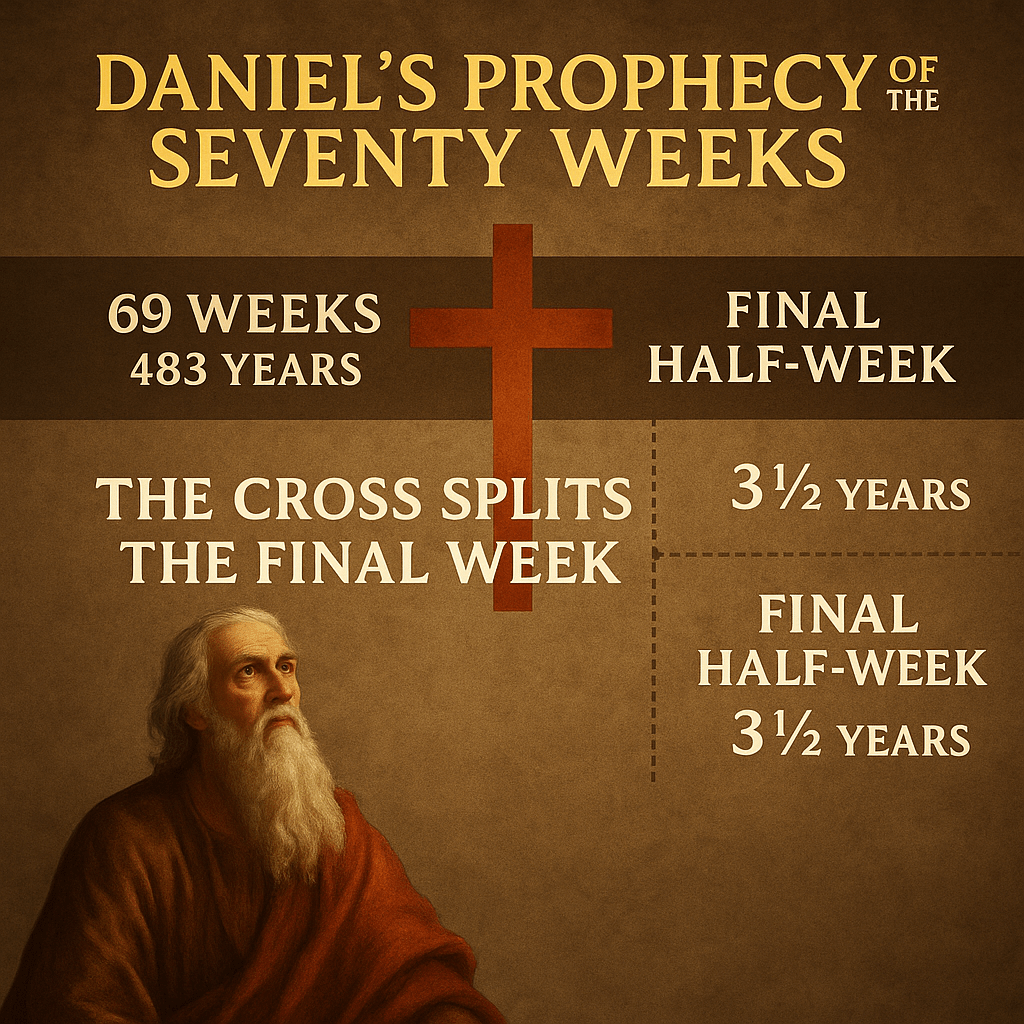
But what you’re laying out is a major paradigm shift. The prophecy isn’t primarily about the triumph of evil, or a massive gap in time, or a future political monster. It’s fundamentally about Christ’s completed work—Christ as the covenant keeper. And here’s the big claim: the cross doesn’t merely appear inside the prophecy. The cross splits the final week right down the middle.

To see why this matters, we have to start with Daniel himself. He’s not sitting in comfort, mapping out futuristic chaos like a prophecy engineer. He’s in Babylon, in exile, deep inside the capital of captivity. He’s distraught. He’s reading Jeremiah. He realizes the 70 years of exile are nearly over—and he prays with desperate hope.

He isn’t hunting secret codes. He’s looking for proof of God’s faithfulness when everything looks like ruin.

And his prayer in Daniel 9 says exactly that. He appeals to God as the great and dreadful God who keeps covenant and mercy. That’s verse 4. Daniel is basically holding God to God’s own promise—despite Israel having completely broken their side of the covenant. Daniel knows God is faithful even when his people are not.

Then Gabriel shows up with an answer to that covenant-focused prayer: a highly specific prophetic timetable. And right there in verse 24, Gabriel gives six objectives. And this is where your Messiah-centered reading becomes so compelling.

Because if this prophecy were mainly about a future political tyrant, you’d expect language about military power, geopolitics, and empire-building.

But that’s not what we get.

We get cosmic, redemptive goals:

  • to finish the transgression
  • to make an end of sins
  • to make reconciliation for iniquity
  • to bring in everlasting righteousness

Let’s slow down and be honest. What human ruler can “finish the transgression”? That isn’t political reform. That’s a definitive solution to the root problem of sin and rebellion. No king can accomplish that. No treaty can achieve that. That’s God-level work.

And “everlasting righteousness”? Sure, a human leader might enforce temporary law and order. But only the Anointed One can bring righteousness that lasts forever.

So the focus shifts: this stops looking like a prophecy about future political chaos and starts reading like a declaration of Messiah-driven redemption.

Then the timeline narrows in. Gabriel says that after 69 weeks—483 years—“Messiah the Prince” comes. That’s verse 25. Then the Messiah is “cut off, but not for himself.” That’s verse 26. So the prophecy places the death of the Messiah after the 69th week.

And now we hit the controversy: Daniel 9:27.

Traditional readings usually argue that since the Messiah is cut off after the 69th week, there must be a vast time gap between week 69 and week 70—the so-called great parenthesis. And in that view, the “he” in verse 27 becomes a different figure altogether: a future Antichrist who makes a seven-year political covenant with Israel, triggering the tribulation.

But your argument pushes back hard, and your counterpoint is surprisingly simple: Hebrew grammar.

The subject in verse 26 is the Messiah—the one who is cut off. So why assume a brand-new, unnamed character suddenly hijacks the action in the very next line?

You wouldn’t—at least not without a strong reason.

So the most natural, grammatically faithful reading is that the Messiah remains the subject in verse 27: the Messiah is the one who “confirms the covenant.”

That changes everything.

It implies the 490 years run as a continuous prophetic arc, not a stop-and-start timeline. And it places the Messiah’s ministry and death inside the 70th week.

And if the Messiah is the covenant confirmer, then we have to ask: how does he confirm it?

Not with a political peace treaty.

In your framing, this confirmation is done with blood. The thought jumps straight to the Last Supper: “This cup is the New Testament in my blood.” The Messiah ratifies the new covenant with his sacrifice.

Under this framework, the 70th week begins with Christ’s ministry about three and a half years before his death.

Then comes the next crucial phrase in verse 27: “in the midst of the week.”

That means three and a half years into that final seven-year period. And the verse says he will cause sacrifice and offering to cease.

If the Messiah is still the subject, then Christ himself brings the sacrificial system to its ordained conclusion—not by issuing a policy memo, but by making the entire system theologically unnecessary through the once-for-all sacrifice of the cross.

You support this connection to the cross with three strong lines of evidence:

  1. The veil of the temple torn
    At the moment of Christ’s death, the veil is torn in two from top to bottom (Matthew 27:51). That’s not random symbolism. That’s God announcing that access is now open and the old order has reached its climax.
  2. The shadow-to-substance argument
    Hebrews describes the old sacrifices as shadows. The moment the true sacrifice arrives—Christ himself—the shadows lose their purpose. Why keep sacrificing animals when the Lamb of God has completed the ultimate sacrifice? Hebrews 10 drives that logic home.

So the message is simple and sharp: the Lamb of God ended the need for lambs of men.

With Christ’s death three and a half years into the 70th week, the new covenant is inaugurated and the need for temple sacrifice is permanently ended.

That means:

  • 69 weeks (483 years) bring us to the Messiah’s arrival.
  • The first half of the 70th week (3.5 years) brings us to his death.

That’s 486.5 years of fulfillment, with the cross as the hinge of redemptive history.

So what about the remaining half-week?

Here’s your conclusion: a final, unfulfilled prophetic half-week remains. That’s three and a half years—also described as 1260 days, or “time, times, and half a time.”

And that has huge implications for how people think about the tribulation.

In the traditional model, the future tribulation is a full seven years. Under your Messiah-centric model, the future period is cut in half immediately. If Christ fulfills the covenant confirmation and ends sacrifice at the midpoint of the week, then the future period of final judgment and redemption aligns with the remaining three and a half years.

And that shorter timeframe fits the recurring apocalyptic numbers in Revelation: 1260 days, 42 months—especially in chapters 11, 12, and 13.

So, in this view, the 70th week is neither entirely future nor entirely past. It’s divided by the cross. The Messiah claims the first half through his ministry and sacrifice. The church age follows. And history will eventually see the completion of the final half-week by God’s sovereign appointment, particularly in God’s final dealings with Israel and the world.

All of this loops back to the emotional engine of Daniel 9.

Daniel starts in exile, praying for covenant faithfulness in the shadow of judgment. And God answers with a prophecy that doesn’t merely promise restoration—it promises covenant fulfillment enacted by God himself.

So this reading pushes Daniel 9 away from being a scary chronicle of future chaos and back toward being what it may have always been: a Messiah-centered declaration that God finishes what he begins.

And your summary of the Messiah’s four key actions in this prophecy lands cleanly:

  • He appears.
  • He is cut off.
  • He confirms the covenant.
  • He brings sacrifice to an end.

In that light, Daniel 9 becomes less a cryptic puzzle and more a Christ-centered roadmap.

And it leaves the listener with a haunting, thoughtful question:
If the first half-week completed the sacrificial inauguration of the new covenant—finalizing reconciliation and ending the need for sacrifice—what specific divine purposes must unfold within the final, shortened three and a half years?

What completion is left when the covenant itself is already secured?

That’s the weight of the remaining half-week. That’s the tension the prophecy invites you to sit with.Let’s unpack Daniel’s Prophecy of the Seventy Weeks—because this might be the most complex and most debated timeline in all of Scripture, and it’s way too easy to get lost in the math and miss the heartbeat of the message.

When most of us hear “70 weeks,” we immediately start doing mental calculations. We’re talking about 490 years. And the traditional approach often slices that timeline up, then pushes the 70th week far into the future—reserved for a future tribulation and the rise of someone labeled the Antichrist. That’s the default framework for a lot of people.

But what you’re laying out is a major paradigm shift. The prophecy isn’t primarily about the triumph of evil, or a massive gap in time, or a future political monster. It’s fundamentally about Christ’s completed work—Christ as the covenant keeper. And here’s the big claim: the cross doesn’t merely appear inside the prophecy. The cross splits the final week right down the middle.

To see why this matters, we have to start with Daniel himself. He’s not sitting in comfort, mapping out futuristic chaos like a prophecy engineer. He’s in Babylon, in exile, deep inside the capital of captivity. He’s distraught. He’s reading Jeremiah. He realizes the 70 years of exile are nearly over—and he prays with desperate hope.

He isn’t hunting secret codes. He’s looking for proof of God’s faithfulness when everything looks like ruin.

And his prayer in Daniel 9 says exactly that. He appeals to God as the great and dreadful God who keeps covenant and mercy. That’s verse 4. Daniel is basically holding God to God’s own promise—despite Israel having completely broken their side of the covenant. Daniel knows God is faithful even when his people are not.

Then Gabriel shows up with an answer to that covenant-focused prayer: a highly specific prophetic timetable. And right there in verse 24, Gabriel gives six objectives. And this is where your Messiah-centered reading becomes so compelling.

Because if this prophecy were mainly about a future political tyrant, you’d expect language about military power, geopolitics, and empire-building.

But that’s not what we get.

We get cosmic, redemptive goals:

  • to finish the transgression
  • to make an end of sins
  • to make reconciliation for iniquity
  • to bring in everlasting righteousness

Let’s slow down and be honest. What human ruler can “finish the transgression”? That isn’t political reform. That’s a definitive solution to the root problem of sin and rebellion. No king can accomplish that. No treaty can achieve that. That’s God-level work.

And “everlasting righteousness”? Sure, a human leader might enforce temporary law and order. But only the Anointed One can bring righteousness that lasts forever.

So the focus shifts: this stops looking like a prophecy about future political chaos and starts reading like a declaration of Messiah-driven redemption.

Then the timeline narrows in. Gabriel says that after 69 weeks—483 years—“Messiah the Prince” comes. That’s verse 25. Then the Messiah is “cut off, but not for himself.” That’s verse 26. So the prophecy places the death of the Messiah after the 69th week.

And now we hit the controversy: Daniel 9:27.

Traditional readings usually argue that since the Messiah is cut off after the 69th week, there must be a vast time gap between week 69 and week 70—the so-called great parenthesis. And in that view, the “he” in verse 27 becomes a different figure altogether: a future Antichrist who makes a seven-year political covenant with Israel, triggering the tribulation.

But your argument pushes back hard, and your counterpoint is surprisingly simple: Hebrew grammar.

The subject in verse 26 is the Messiah—the one who is cut off. So why assume a brand-new, unnamed character suddenly hijacks the action in the very next line?

You wouldn’t—at least not without a strong reason.

So the most natural, grammatically faithful reading is that the Messiah remains the subject in verse 27: the Messiah is the one who “confirms the covenant.”

That changes everything.

It implies the 490 years run as a continuous prophetic arc, not a stop-and-start timeline. And it places the Messiah’s ministry and death inside the 70th week.

And if the Messiah is the covenant confirmer, then we have to ask: how does he confirm it?

Not with a political peace treaty.

In your framing, this confirmation is done with blood. The thought jumps straight to the Last Supper: “This cup is the New Testament in my blood.” The Messiah ratifies the new covenant with his sacrifice.

Under this framework, the 70th week begins with Christ’s ministry about three and a half years before his death.

Then comes the next crucial phrase in verse 27: “in the midst of the week.”

That means three and a half years into that final seven-year period. And the verse says he will cause sacrifice and offering to cease.

If the Messiah is still the subject, then Christ himself brings the sacrificial system to its ordained conclusion—not by issuing a policy memo, but by making the entire system theologically unnecessary through the once-for-all sacrifice of the cross.

You support this connection to the cross with three strong lines of evidence:

  1. The veil of the temple torn
    At the moment of Christ’s death, the veil is torn in two from top to bottom (Matthew 27:51). That’s not random symbolism. That’s God announcing that access is now open and the old order has reached its climax.
  2. The shadow-to-substance argument
    Hebrews describes the old sacrifices as shadows. The moment the true sacrifice arrives—Christ himself—the shadows lose their purpose. Why keep sacrificing animals when the Lamb of God has completed the ultimate sacrifice? Hebrews 10 drives that logic home.

So the message is simple and sharp: the Lamb of God ended the need for lambs of men.

With Christ’s death three and a half years into the 70th week, the new covenant is inaugurated and the need for temple sacrifice is permanently ended.

That means:

  • 69 weeks (483 years) bring us to the Messiah’s arrival.
  • The first half of the 70th week (3.5 years) brings us to his death.

That’s 486.5 years of fulfillment, with the cross as the hinge of redemptive history.

So what about the remaining half-week?

Here’s your conclusion: a final, unfulfilled prophetic half-week remains. That’s three and a half years—also described as 1260 days, or “time, times, and half a time.”

And that has huge implications for how people think about the tribulation.

In the traditional model, the future tribulation is a full seven years. Under your Messiah-centric model, the future period is cut in half immediately. If Christ fulfills the covenant confirmation and ends sacrifice at the midpoint of the week, then the future period of final judgment and redemption aligns with the remaining three and a half years.

And that shorter timeframe fits the recurring apocalyptic numbers in Revelation: 1260 days, 42 months—especially in chapters 11, 12, and 13.

So, in this view, the 70th week is neither entirely future nor entirely past. It’s divided by the cross. The Messiah claims the first half through his ministry and sacrifice. The church age follows. And history will eventually see the completion of the final half-week by God’s sovereign appointment, particularly in God’s final dealings with Israel and the world.

All of this loops back to the emotional engine of Daniel 9.

Daniel starts in exile, praying for covenant faithfulness in the shadow of judgment. And God answers with a prophecy that doesn’t merely promise restoration—it promises covenant fulfillment enacted by God himself.

So this reading pushes Daniel 9 away from being a scary chronicle of future chaos and back toward being what it may have always been: a Messiah-centered declaration that God finishes what he begins.

And your summary of the Messiah’s four key actions in this prophecy lands cleanly:

  • He appears.
  • He is cut off.
  • He confirms the covenant.
  • He brings sacrifice to an end.

In that light, Daniel 9 becomes less a cryptic puzzle and more a Christ-centered roadmap.

And it leaves the listener with a haunting, thoughtful question:
If the first half-week completed the sacrificial inauguration of the new covenant—finalizing reconciliation and ending the need for sacrifice—what specific divine purposes must unfold within the final, shortened three and a half years?

What completion is left when the covenant itself is already secured?

That’s the weight of the remaining half-week. That’s the tension the prophecy invites you to sit with.

Spiritual Malnutrition: The Hidden Hunger Most Christians Ignore

God designed us to live from the inside out—spirit first, then soul, then body—and His Word is the food that keeps that whole system alive and healthy. When we ignore that order, everything starts to wobble: our thoughts, our emotions, even our physical strength. When we honor it, life begins to feel aligned again, like a machine finally running the way its Maker intended.

Scripture shows that we are not just a body with some vague “inner life.” Paul writes, “I pray God your whole spirit and soul and body be preserved blameless” (1 Thessalonians 5:23). That’s not random wording. It suggests a clear structure: spirit, then soul, then body. The spirit is the deepest part of you—the real “you,” where you are aware of God, where you sense and know things that go beyond logic (Romans 8:16). When someone is born again, that spirit is made new, righteous, and united with the Holy Spirit. The soul sits in the middle and includes your mind, will, and emotions—the part of you that thinks, chooses, and feels. The body is your visible, physical shell, the way you show up and act in the world.

The Bible even tells us that God’s Word can reach into these layers and separate them in a way nothing else can. Hebrews 4:12 says the Word of God is so sharp it can divide soul and spirit, “joints and marrow.” In other words, it can cut right down into the deepest places and show what’s happening where. Only God’s Word can do that, because only God’s Word is designed to feed and sort out those different parts in the right order.

Just like your body needs food, your spirit needs food—and not just occasionally. Jesus said, “Man shall not live by bread alone, but by every word that proceeds out of the mouth of God” (Matthew 4:4). Bread keeps the body going; God’s Word feds the spirit and quickens our souls. Peter compares believers to newborn babies who should crave “the sincere milk of the word” so they can grow (1 Peter 2:2). No food, no growth. That’s true physically, and Scripture says it’s just as true spiritually.

Job understood this long before any of us. He said he valued God’s words more than his necessary food (Job 23:12). He saw that real life is not just about keeping the body going; it’s about feeding the spirit. Jesus agreed: “The words that I speak unto you, they are spirit, and they are life” (John 6:63). God’s Word is spiritual in nature and life-giving in effect. When your spirit takes it in, something living is happening, even when you don’t feel anything dramatic.

Now think about what happens when you don’t eat. When the body goes without food, it gets weak, tired, and shaky. You feel faint, you can’t focus, and your emotions often sink. Scripture uses that picture to help us understand what happens on the inside when we neglect spiritual food. David described his inner dryness this way: when he kept silent and held things in before God, he said his bones felt like they were aging and his strength was gone “as in the drought of summer” (Psalm 32:3–4). His spiritual condition was affecting his physical and emotional state.

Proverbs gives the same idea in a sentence: “A broken spirit drieth the bones,” but “a merry heart doeth good like a medicine” (Proverbs 17:22). When the spirit is crushed, the body feels it. When the inner life is joyful, it’s like medicine to the whole person. God built us so that what happens in the spirit eventually touches the soul and finally shows up in the body. This is not an accident. God designed life to flow from the deepest part of us outward.

When the spirit is fed with the Word of God, the first place the effects show up is in the soul—how we think, feel, and choose. Scripture renews the mind, which is part of the soul. Paul says, “Be transformed by the renewing of your mind” (Romans 12:2). And what is the benefit of that? The passage goes on to say that you will prove that God’s will is good, perfect and acceptable!

The Word doesn’t just give us new ideas; it reshapes how we see reality. It also brings peace to the heart: “Great peace have they which love thy law” (Psalm 119:165). Love the Word, and peace follows. Jeremiah said, “Thy word was unto me the joy and rejoicing of mine heart” (Jeremiah 15:16). Joy doesn’t begin in the emotions; it starts with the Word reaching the spirit and then flowing out into the feelings. David could say, “He restoreth my soul” (Psalm 23:3), because God’s truth reaches weary, damaged places inside and brings them back to life.

So the chain looks like this: the Word strengthens the spirit, the strengthened spirit renews the soul, and then both begin to affect the body and even the physical world around you. Paul describes it like this: that God would strengthen us “with might by his Spirit in the inner man” (Ephesians 3:16). The Holy Spirit uses the Word to empower the “inner man”—your spirit. That inner strength then shows up in clearer thinking, better attitudes, steadier emotions, and wiser choices.

From there, Scripture shows that the body is not left out of the process. What is planted in the heart eventually appears in how we live, act, and even in our health. Solomon urges his son to pay attention to God’s words and keep them in his heart because “they are life unto those that find them, and health to ALL their flesh” (Proverbs 4:20–22). Notice the order: the Word enters, settles in the heart, and then becomes life and health to the body. It’s inside → outside every time.

John echoes this when he says, “I wish above all things that thou mayest prosper and be in health, even as thy soul prospereth” (3 John 2). The prosperity and health he longs for are tied to the condition of the soul. God’s pattern is consistent: the state of your inner life sets the tone for your outer life.

Put simply, God designed spirit, soul, and body to work as a team—with the spirit leading, not trailing behind. The Spirit of God lives in the believer’s spirit and produces fruit—love, joy, peace, and so on (Galatians 5:22–23). But for that fruit to shape the rest of life, the spirit must be fed. When the spirit is nourished by the Word, the soul is refreshed, reordered, and stabilized. Then the body is guided and strengthened by that inner overflow instead of being driven purely by feelings or circumstances.

Ignore spiritual food, and the results are predictable: weakness, confusion, lack of stability, and reduced capacity to handle life. Feed the spirit, and you see the opposite: strength, clarity, peace, and steadiness. This isn’t a motivational slogan; it’s the order of creation as Scripture reveals it.

Finally, Jesus ties all of this to the renewing of the mind and to trusting Him. A renewed mind is not a luxury; it’s how we learn to recognize God’s will and walk in spiritual strength (Romans 12:2). When Jesus says, “Man shall live by every word of God” (Matthew 4:4), He is not giving a poetic line; He is telling us how human beings actually live as God intended. To believe Him is to take that seriously.

So if Jesus tells us that His Word brings blessing, peace, and spiritual vitality, then valuing mind renewal is really a way of saying, “I trust You, Lord.” Feeding the spirit with the Word becomes an act of faith, not just a habit. We feed on His Word because we believe what He says. We renew our minds because He has told us this will transform us. And we seek the health of spirit, soul, and body because that is how God made us to function: life starting in the spirit, moving through the soul, and reaching all the way out to the body.

Human History is One Week Long

2 Peter 3:8 isn’t just a comforting verse about God being “outside of time.” Peter drops it right in the middle of an end-times conversation, answering people who were already asking, “Where is the promise of His coming?” He describes the Day of the Lord, the final judgment, the destruction and renewal of the world—and in that context he says, “With the Lord one day is as a thousand years, and a thousand years as one day.” That sounds less like a random poetic flourish and more like a key: if God sometimes chooses to “think” in thousand-year blocks that He calls “days,” then maybe the Creation week itself is a map of how long human history will run before that Day arrives. [Inference]

Imagine time itself as a seven-day week on God’s calendar. The first “day” begins with Adam walking out of Eden into a world that suddenly feels heavy: sweat on his forehead, thorns in the ground, death now part of the story. Humanity spreads, falls deeper into violence, reaches the days of Noah and the flood, then stumbles toward Babel, where God scatters the nations. That long, rough stretch from Adam to Abraham covers about two thousand years in many traditional chronologies—one thousand-year “day,” then another. The third “day” begins when God calls Abraham and starts working not just with humanity in general but with one particular family that will become one particular nation. For roughly another two thousand years, through patriarchs and prophets, judges and kings, exile and return, God writes His promises into the life of Israel. The Law is given, sacrifices are offered, feasts are kept, and the prophets keep pointing forward to Someone who is coming. By the time Jesus appears, you’ve moved through four thousand years—four great “days” of a thousand years each—of preparation. [Inference]

Now freeze the frame at the cross. If you treat the end of the fourth “day” as the death and resurrection of Jesus around the year 30, the timing suddenly sharpens. On that Passover in 30 AD, the fourth day closes: all the shadows and symbols of the previous four thousand years collide on one hill outside Jerusalem. The true Lamb is sacrificed, the true High Priest intercedes, the true Temple presence is unveiled as the curtain tears. From God’s point of view, four vast “days” have been marching toward this single weekend. When Jesus cries, “It is finished,” the age of preparation ends, and the fifth “day” begins not at His birth, not at Pentecost, but at the moment His blood seals the new covenant. [Speculation]

If one prophetic “day” is a thousand years, that fifth day runs from about year 30 to 1030, and the sixth day from about 1030 to 2030. That puts us living at the fading edge of the sixth day, watching the sun slide toward the horizon. We are not just generically “in the last days” the way every generation has been since the apostles; on this view, we are about at the end of the sixth thousand years of human history, standing near the boundary between the work-week of the world and the Sabbath of the world. No one can nail the exact year, and the biblical warnings against setting dates still stand untouched, which is why that little word “about” matters so much. But measured from the cross in year 30 as the end of the fourth “day,” two more thousand-year “days” bring you right into our century. [Speculation]

This idea isn’t a clever modern internet chart; it’s an old story. In the Talmud, some Jewish rabbis taught that the world would last six thousand years and then enter a thousand-year “Sabbath,” echoing God’s six days of work and one day of rest. They even divided those six thousand years into broad eras: two thousand years of “chaos” or “desolation” before Abraham, two thousand years of Torah and Israel’s special calling, and two thousand years linked with the days of Messiah. [Inference] Early Christians picked up the same pattern. A second-century work called the Epistle of Barnabas explicitly connects the six days of creation with six thousand years of history and says that the seventh day foreshadows a thousand-year reign of Christ. The church father Irenaeus, also in the second century, argued similarly: just as the world was made in six days, so it would run for six thousand years, with a seventh thousand-year kingdom as its Sabbath. Later writers like Hippolytus echoed the same scheme. For them, 2 Peter 3:8 wasn’t just reassurance that God is patient; it was a Spirit-given hint that those “days” in Genesis could be read as thousand-year blocks leading up to the kingdom. [Inference]

Seen like this, Peter’s strange sentence in 2 Peter 3:8 feels less random and more surgical. He’s addressing people who are tempted to mock the apparent delay of Christ’s return: “Where is this coming He promised?” His answer is not, “Relax, it’s symbolic, He’ll never actually come,” but the exact opposite: the Day of the Lord will come; the heavens will pass away with a roar; the earth will be exposed; new heavens and a new earth are waiting. Right in the middle of that, he says, “Don’t forget this one thing: with the Lord one day is as a thousand years…” It’s as if the Spirit is saying, “If you only count by your own little clock, you’ll misread the delay. God is working on a week-long scale you haven’t fully grasped.” That’s where the Creation pattern and the thousand-year “days” snap together: six days of labor, one day of rest; six thousand years of human history under the curse and the cross, one thousand years of visible, righteous rule under Christ. [Inference]

Does this mean we can mark our calendars and circle a date? Absolutely not. Peter warns in the same chapter that the Day of the Lord will come like a thief, and Jesus Himself said no one knows the day or the hour. The point of this six-days-then-Sabbath picture isn’t to make us smug chart-keepers; it’s to make us sober, awake servants. If four prophetic “days” carried the world from Adam to the cross and two more have nearly carried it from the cross to now, then we are living, by this way of seeing, in the late afternoon of the sixth day. That’s not a reason to speculate endlessly; it’s a reason to live differently. If the week is almost over, do you really want to spend the last hours scrolling, drifting, and arguing, or do you want to be found faithful when the sun finally sets and the great Sabbath begins? [Speculation]

In that light, the entire sweep of history starts to look like a story written around one Person. Four thousand years, four “days,” preparing the stage for Jesus’ death and resurrection around year 30; two thousand more years, two “days,” sending the news of that victory to every tribe and tongue; and then, at the edge of the sixth day, the world waiting for the curtain to rise on the seventh: a thousand years when Christ reigns and the earth finally breathes. Whether God chooses to align the end precisely with our calendars or not, the pattern itself is powerful. It says history is not a random loop; it’s a measured week. And if 2 Peter 3:8 is indeed the key that unlocks that pattern, then we are not just reading about the end times—we are living very near the end of the sixth day.

Seven Benefits of Jesus’ Blood

It’s honestly amazing when you stop and think about it — the blood of Jesus doesn’t just do one thing. It’s not just forgiveness or redemption; it’s seven powerful, life-changing gifts poured into your life through one act of love. The Bible describes the blood of Christ like a divine key that has unlocked every door between you and God. It didn’t just wipe away your past — it gives you a new standing, a new peace, and even a new kind of power. The more you understand what His blood has done for you, the more you realize you’re living under a miracle.

First, His blood brings forgiveness. Every one of us has made choices that left scars — on others, on ourselves, and on our relationship with God. But when Jesus shed His blood, He paid the full cost of every wrong. Scripture says, “In Him we have redemption through His blood, the forgiveness of sins, in accordance with the riches of God’s grace” (Ephesians 1:7). There’s no “sin too big” clause, no fine print. Forgiveness through His blood isn’t partial or probationary; it’s complete. It doesn’t ask you to earn your way back to God. It simply says, “You’re free.”

Then comes cleansing — that deep, inner healing no human therapy can reach. You can be forgiven and still feel unclean, but the blood of Jesus washes more than your record; it washes your conscience. The Bible reminds us that “the blood of Jesus Christ His Son cleanses us from all sin” (1 John 1:7) and that “the blood of Christ… cleanses your conscience from dead works to serve the living God” (Hebrews 9:14). His blood takes away the inner voice that says, “You’ll never be good enough,” and replaces it with the quiet assurance, “You’re Mine.” The blood silences shame and lets you breathe again.

His blood also brings justification, which means you’re not just forgiven — you’re declared righteous. Picture standing before a judge who looks at every charge against you, then stamps your case “closed” because Jesus already took the sentence. “Since we have now been justified by His blood, how much more shall we be saved from God’s wrath through Him!” (Romans 5:9). You walk out of that courtroom not as a criminal but as someone in right standing with God. That’s more than mercy; that’s grace.

Then there’s redemption. Humanity sold itself into slavery to sin, but the blood of Jesus became the ransom that set us free. As Peter wrote, “You were not redeemed with corruptible things, like silver or gold… but with the precious blood of Christ, as of a lamb without blemish and without spot” (1 Peter 1:18–19). He didn’t just open the cell door; He paid for your release with His own life. Your worth isn’t tied to what you’ve done wrong but to what He thought you were worth dying for.

His blood also gives peace with God. Sin once made us strangers to Him, but the blood turned enemies into family. The cross wasn’t just about punishment; it was about reconciliation — restoring a broken relationship. “Having made peace through the blood of His cross, by Him to reconcile all things unto Himself” (Colossians 1:20). That peace isn’t fragile or conditional; it’s settled forever.

And now, because of that same blood, we have access to God’s presence. In the Old Testament, only one priest could enter the Most Holy Place once a year. But when Jesus died, the temple curtain ripped in two from top to bottom — God’s way of saying, “Come on in.” Scripture tells us, “We have confidence to enter the Most Holy Place by the blood of Jesus” (Hebrews 10:19). Through His blood, you can talk to God anytime, anywhere — no barriers, no rituals, no waiting your turn.

Finally, His blood gives victory. The same blood that forgave you also disarms the enemy. “They overcame him by the blood of the Lamb and by the word of their testimony” (Revelation 12:11). That means when fear, guilt, or temptation come knocking, you can stand your ground because the blood of Jesus already declared the outcome — victory.

So yes, it’s staggering to realize — seven different ways, one single sacrifice. His blood forgives, cleanses, justifies, redeems, reconciles, opens, and conquers. Every drop tells a story of love so powerful that it rewrote history — and yours too. When you really see what His blood has done, you can’t help but stand in awe.