Clarity Was Always the Promise

The Fog
There’s a kind of fog that has nothing to do with weather. It settles in the mind — a low-grade confusion about who you are, what you’re supposed to do, where God fits into the middle of your actual life. Most believers have made a kind of peace with it, as though confusion were simply the human condition. It isn’t. It’s what happens when a mind has never been taught to focus.
Scripture’s promise isn’t only salvation from sin — as staggering as that is. It’s transformation. A wholesale renovation of the inner life that produces clarity, peace, purpose, and freedom. Paul wrote to the Romans with disarming directness: “Be transformed by the renewing of your mind” (Romans 12:2). Not informed. Not inspired. Transformed. And he named the exact address of that transformation: the mind.


What follows is a five-stage journey that Scripture maps with remarkable consistency. It isn’t a new formula — it’s an ancient path walked by prophets, psalmists, and apostles, now laid out plainly for anyone who hungers for more than Sunday-morning Christianity. Seeking leads to Meditation, which produces Stillness, which enables a Transformed Mind, which changes everything else.


Clarity was never withheld from you. It was waiting for you to get quiet enough to receive it.

Stage One: Seek
“If you look for it as for silver and search for it as for hidden treasure, then you will understand the fear of the Lord.” — Proverbs 2:4-5


Nothing on this journey begins without desire. The wisdom literature is unambiguous: wisdom, understanding, and knowledge of God are things you search for, cry out for, dig for. The posture is unmistakably active.
To seek is already to focus. The moment a believer turns their attention toward God — not out of religious obligation, but with genuine hunger — they’ve fired the ignition. And seeking, by definition, is not passive. The Hebrew word in Proverbs 2 for “search” is the same word used for a miner working a seam of precious metal: deliberate, sustained, expectant, effortful. Scrolling through a devotional while checking notifications isn’t it. A two-minute prayer offered to a distracted mind on the way out the door isn’t it either.
James says it plainly: “Draw near to God and He will draw near to you” (4:8). The initiative is yours. The response is His. But the sequence matters. Seeking comes first — and it must be real.

Stage Two: Meditate
“Meditate on it day and night, so that you may be careful to do everything written in it. Then you will be prosperous and successful.” — Joshua 1:8


Seeking sets the direction. Meditation sustains the journey.
The Hebrew word for meditate — hagah — carries the image of a low, ruminating murmur, like the sound an animal makes chewing its cud. The picture is deliberate. A cow doesn’t swallow grass once and move on. It brings it back up, works it over again, extracts what it missed the first time. Biblical meditation is the cognitive and spiritual equivalent: returning to the Word, the promise, the truth, and working it until it yields what casual reading never will.
This is why Joshua 1:8 attaches prosperity and success not to talent or strategy, but to sustained meditation on God’s Word. And Psalm 1 doesn’t say the meditating person tries to be fruitful — it says they simply yield fruit in season, naturally, the way a tree does when its roots go deep enough to reach water.
The psalmist makes a remarkable claim: “I have more insight than all my teachers, for I meditate on your statutes” (119:99). Not equal to his teachers. More than. The difference isn’t intelligence — it’s depth of processing. Teachers transfer information; meditation produces internalization. There’s a difference between knowing about something and actually knowing it. Meditation is the bridge between those two realities.


For the believer who’s wondered why the Word doesn’t seem to “work” in their life, the honest question isn’t whether Scripture is powerful. It’s whether engagement has been deep enough. Meditation is the depth charge.

Stage Three: Stillness
“Be still, and know that I am God.” — Psalm 46:10


Here’s what most teaching on stillness gets backwards: stillness is not where you start. It’s where sustained meditation takes you.
Trying to be still without first meditating is like standing on the bank of a turbulent river and commanding it to stop. You have to work upstream. When the mind has been genuinely engaged — when it’s moved past the restlessness of an untrained thought life and found its footing in sustained focus on truth — stillness begins to emerge. Not as an effort. As an arrival. The noise doesn’t get quieter because you try harder to ignore it. It gets quieter because something more substantial has taken up residence in its place.
Psalm 46:10 is often quoted as an invitation to relax. It isn’t. In context, nations are in uproar, kingdoms are falling, the earth itself is giving way. “Be still” here isn’t a suggestion to take a deep breath. It’s a command to stop manufacturing your own solutions long enough to perceive the sovereignty of God. This stillness is an act of radical trust.


Habakkuk’s posture is equally instructive. “I will stand at my watch and station myself on the ramparts” (2:1). He doesn’t wait passively — he stations himself. A military term. Deliberate, prepared watchfulness. This is what meditation produces: not vacancy but readiness. Not emptiness but availability.


The unstill mind, by contrast, never truly quiets. It’s reactive, fragmented, driven by whatever stimulus arrived last. Anxiety is its baseline. Distraction is its default. Research by Harvard psychologists found that the human mind wanders roughly 47% of the time — and that a wandering mind is consistently a less happy mind. Stillness isn’t a spiritual luxury. It’s a form of health. And it’s in this stillness that the next stage becomes possible.

Stage Four: The Transformed Mind
“Do not conform to the pattern of this world, but be transformed by the renewing of your mind.” — Romans 12:2
The word Paul chose — metamorphoo — is where we get metamorphosis. He isn’t describing a mind that’s been slightly improved or gently adjusted. He’s describing a mind that has undergone a fundamental change of nature, the way a caterpillar doesn’t merely grow wings but becomes something categorically different.


This transformation isn’t a one-time event. It’s the cumulative result of sustained seeking, sustained meditation, and the stillness those disciplines produce. It’s a living condition — maintained by continued engagement with truth, slowly and irreversibly reshaping how you see everything.


Notice what the transformed mind gains: the ability to “test and approve God’s will” (Romans 12:2). Not a booming voice from heaven, not perpetual supernatural signs — but a mind so shaped by truth that discernment becomes natural. You begin to know what’s right not merely because someone told you, but because your mind has been renovated from the inside.
Isaiah adds the interior experience: “You will keep in perfect peace those whose minds are steadfast” (26:3). The Hebrew is shalom — not merely the absence of conflict, but the presence of completeness. Nothing missing. Nothing broken. Not peace as a feeling that comes and goes with your circumstances. Peace as the baseline condition of the renovated mind.


And Paul’s instruction in Philippians 4:8 functions as the maintenance manual — a deliberate governance of what the mind dwells on. The transformed mind doesn’t passively receive whatever the world feeds it. It chooses. It governs its own content. Not denial. Stewardship.

Stage Five: When the Mind Changes, Everything Changes
A transformed mind doesn’t stay in your head. It leaks — into your relationships, your decisions, your emotional life, your sense of purpose, and your capacity to navigate suffering without being destroyed by it.
Fear and anxiety lose their grip. The untrained mind defaults to worst-case projections, rehearsing catastrophes that haven’t happened and may never happen. The mind that has been renewed by truth doesn’t stop encountering hard things — it stops being governed by them. Paul calls it a “sound mind” — sophronismos, self-discipline, sobriety of thought. You still feel the storm. You just don’t live inside it.


Purpose comes into focus. The disorientation most believers feel about calling and direction is not primarily a lack of information. It’s a mind too noisy to hear. God doesn’t typically shout. He speaks to minds that have been quieted enough to listen. The transformed mind, settled into stillness, becomes capable of a discernment that would have been impossible in the chaos.
Relationships deepen. The reactive mind does enormous damage to the people around it. It speaks before it thinks, interprets every offense through the lens of its own wounds, and makes every relational difficulty about itself. The person whose inner life has been stabilized by truth becomes slower to anger, quicker to listen, more genuinely empathetic. The fruit of the Spirit — love, joy, peace, patience, kindness — isn’t a list of behaviors to perform. It’s what grows naturally from a cultivated inner life.


Suffering becomes navigable. The untrained mind is catastrophized by pain. It reads difficulty as abandonment, failure as finality. The renewed mind holds suffering differently — not because the pain is less real, but because the frame around it has been rebuilt. The believer who has rehearsed the promises in quiet seasons carries that steadiness into the storm.
Creativity and clarity expand. A cluttered, anxious mind cannot access its own best thinking. The mind trained through meditation and brought into stillness operates with a kind of cognitive spaciousness that makes genuine insight possible. God made the mind. He knows how it works at its best.


Intimacy with God deepens. Jesus said, “My sheep hear my voice” (John 10:27). Hearing is a capacity — one that can be developed or atrophied depending on how the inner life is tended. The believer who has built the habit of seeking, meditating, and entering stillness doesn’t have a louder God. They have a more receptive self. The frequency was always broadcasting. The receiver has finally been tuned.

The Promise Was Always There
The path from a noisy, scattered, fear-driven mind to a renewed, peaceful, discerning one has been plainly described in Scripture from the earliest chapters of wisdom literature to the final epistles of the New Testament. It isn’t complicated. It’s simply demanding.


Seek — with the hunger of someone who believes something is actually worth finding. Meditate — with the sustained, returning attention of someone who knows that depth is where the treasure is. Enter the stillness that meditation produces — not as passivity, but as the prepared receptivity of a mind that has done its work. Then watch the transformation show up not just in your thought life, but in every corner of your existence.
The fog doesn’t have to be your permanent address. The noise doesn’t have to be the soundtrack. A transformed mind isn’t the privilege of some spiritual elite. It’s the birthright of every believer willing to walk the path Scripture has always laid out plainly.

“You will keep in perfect peace those whose minds are steadfast, because they trust in you.” — Isaiah 26:3


The promise was always there. It still is.

https://a.co/d/0j3Ryvdg

There is NO 7 Year Tribulation – it’s 3 1/2 Years Only

Let’s unpack Daniel’s Prophecy of the Seventy Weeks—because this might be the most complex and most debated timeline in all of Scripture, and it’s way too easy to get lost in the math and miss the heartbeat of the message.

When most of us hear “70 weeks,” we immediately start doing mental calculations. We’re talking about 490 years. And the traditional approach often slices that timeline up, then pushes the 70th week far into the future—reserved for a future tribulation and the rise of someone labeled the Antichrist. That’s the default framework for a lot of people.

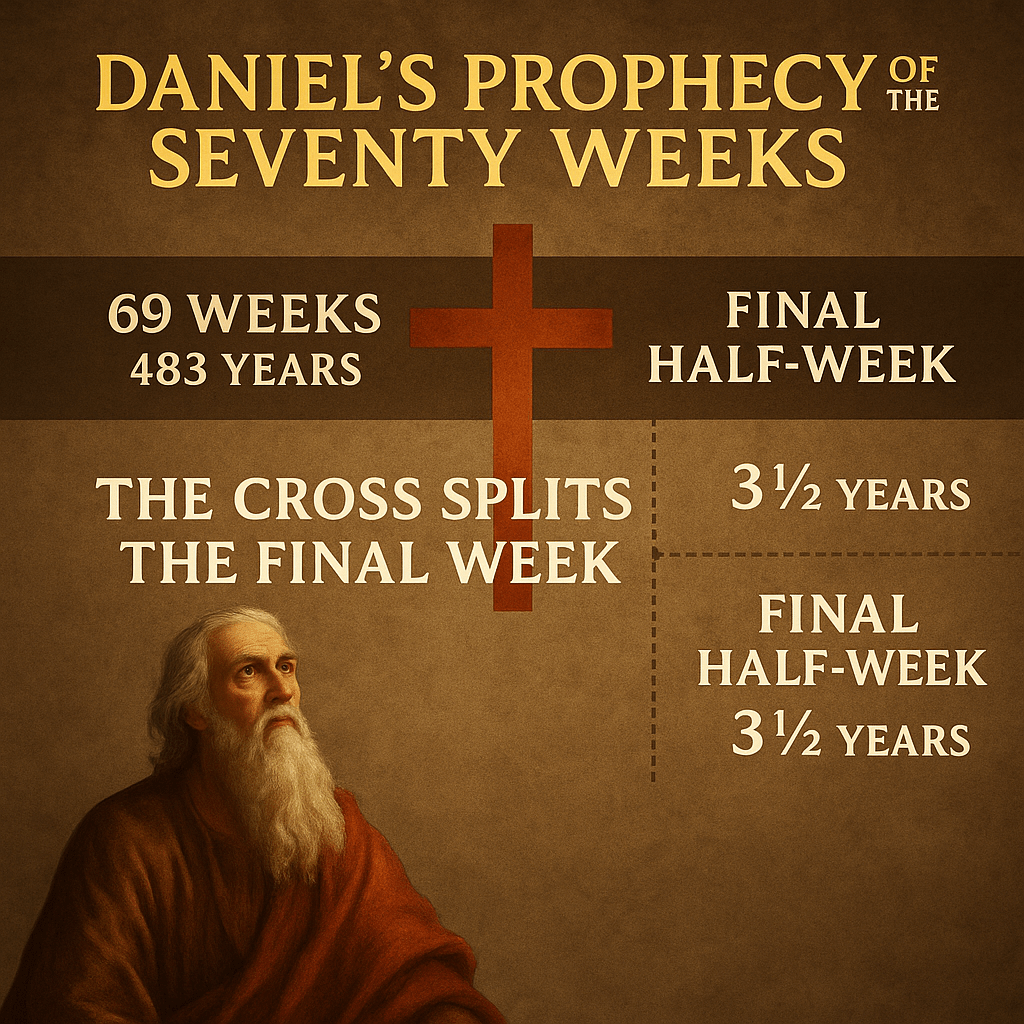
But what you’re laying out is a major paradigm shift. The prophecy isn’t primarily about the triumph of evil, or a massive gap in time, or a future political monster. It’s fundamentally about Christ’s completed work—Christ as the covenant keeper. And here’s the big claim: the cross doesn’t merely appear inside the prophecy. The cross splits the final week right down the middle.

To see why this matters, we have to start with Daniel himself. He’s not sitting in comfort, mapping out futuristic chaos like a prophecy engineer. He’s in Babylon, in exile, deep inside the capital of captivity. He’s distraught. He’s reading Jeremiah. He realizes the 70 years of exile are nearly over—and he prays with desperate hope.

He isn’t hunting secret codes. He’s looking for proof of God’s faithfulness when everything looks like ruin.

And his prayer in Daniel 9 says exactly that. He appeals to God as the great and dreadful God who keeps covenant and mercy. That’s verse 4. Daniel is basically holding God to God’s own promise—despite Israel having completely broken their side of the covenant. Daniel knows God is faithful even when his people are not.

Then Gabriel shows up with an answer to that covenant-focused prayer: a highly specific prophetic timetable. And right there in verse 24, Gabriel gives six objectives. And this is where your Messiah-centered reading becomes so compelling.

Because if this prophecy were mainly about a future political tyrant, you’d expect language about military power, geopolitics, and empire-building.

But that’s not what we get.

We get cosmic, redemptive goals:

  • to finish the transgression
  • to make an end of sins
  • to make reconciliation for iniquity
  • to bring in everlasting righteousness

Let’s slow down and be honest. What human ruler can “finish the transgression”? That isn’t political reform. That’s a definitive solution to the root problem of sin and rebellion. No king can accomplish that. No treaty can achieve that. That’s God-level work.

And “everlasting righteousness”? Sure, a human leader might enforce temporary law and order. But only the Anointed One can bring righteousness that lasts forever.

So the focus shifts: this stops looking like a prophecy about future political chaos and starts reading like a declaration of Messiah-driven redemption.

Then the timeline narrows in. Gabriel says that after 69 weeks—483 years—“Messiah the Prince” comes. That’s verse 25. Then the Messiah is “cut off, but not for himself.” That’s verse 26. So the prophecy places the death of the Messiah after the 69th week.

And now we hit the controversy: Daniel 9:27.

Traditional readings usually argue that since the Messiah is cut off after the 69th week, there must be a vast time gap between week 69 and week 70—the so-called great parenthesis. And in that view, the “he” in verse 27 becomes a different figure altogether: a future Antichrist who makes a seven-year political covenant with Israel, triggering the tribulation.

But your argument pushes back hard, and your counterpoint is surprisingly simple: Hebrew grammar.

The subject in verse 26 is the Messiah—the one who is cut off. So why assume a brand-new, unnamed character suddenly hijacks the action in the very next line?

You wouldn’t—at least not without a strong reason.

So the most natural, grammatically faithful reading is that the Messiah remains the subject in verse 27: the Messiah is the one who “confirms the covenant.”

That changes everything.

It implies the 490 years run as a continuous prophetic arc, not a stop-and-start timeline. And it places the Messiah’s ministry and death inside the 70th week.

And if the Messiah is the covenant confirmer, then we have to ask: how does he confirm it?

Not with a political peace treaty.

In your framing, this confirmation is done with blood. The thought jumps straight to the Last Supper: “This cup is the New Testament in my blood.” The Messiah ratifies the new covenant with his sacrifice.

Under this framework, the 70th week begins with Christ’s ministry about three and a half years before his death.

Then comes the next crucial phrase in verse 27: “in the midst of the week.”

That means three and a half years into that final seven-year period. And the verse says he will cause sacrifice and offering to cease.

If the Messiah is still the subject, then Christ himself brings the sacrificial system to its ordained conclusion—not by issuing a policy memo, but by making the entire system theologically unnecessary through the once-for-all sacrifice of the cross.

You support this connection to the cross with three strong lines of evidence:

  1. The veil of the temple torn
    At the moment of Christ’s death, the veil is torn in two from top to bottom (Matthew 27:51). That’s not random symbolism. That’s God announcing that access is now open and the old order has reached its climax.
  2. The shadow-to-substance argument
    Hebrews describes the old sacrifices as shadows. The moment the true sacrifice arrives—Christ himself—the shadows lose their purpose. Why keep sacrificing animals when the Lamb of God has completed the ultimate sacrifice? Hebrews 10 drives that logic home.

So the message is simple and sharp: the Lamb of God ended the need for lambs of men.

With Christ’s death three and a half years into the 70th week, the new covenant is inaugurated and the need for temple sacrifice is permanently ended.

That means:

  • 69 weeks (483 years) bring us to the Messiah’s arrival.
  • The first half of the 70th week (3.5 years) brings us to his death.

That’s 486.5 years of fulfillment, with the cross as the hinge of redemptive history.

So what about the remaining half-week?

Here’s your conclusion: a final, unfulfilled prophetic half-week remains. That’s three and a half years—also described as 1260 days, or “time, times, and half a time.”

And that has huge implications for how people think about the tribulation.

In the traditional model, the future tribulation is a full seven years. Under your Messiah-centric model, the future period is cut in half immediately. If Christ fulfills the covenant confirmation and ends sacrifice at the midpoint of the week, then the future period of final judgment and redemption aligns with the remaining three and a half years.

And that shorter timeframe fits the recurring apocalyptic numbers in Revelation: 1260 days, 42 months—especially in chapters 11, 12, and 13.

So, in this view, the 70th week is neither entirely future nor entirely past. It’s divided by the cross. The Messiah claims the first half through his ministry and sacrifice. The church age follows. And history will eventually see the completion of the final half-week by God’s sovereign appointment, particularly in God’s final dealings with Israel and the world.

All of this loops back to the emotional engine of Daniel 9.

Daniel starts in exile, praying for covenant faithfulness in the shadow of judgment. And God answers with a prophecy that doesn’t merely promise restoration—it promises covenant fulfillment enacted by God himself.

So this reading pushes Daniel 9 away from being a scary chronicle of future chaos and back toward being what it may have always been: a Messiah-centered declaration that God finishes what he begins.

And your summary of the Messiah’s four key actions in this prophecy lands cleanly:

  • He appears.
  • He is cut off.
  • He confirms the covenant.
  • He brings sacrifice to an end.

In that light, Daniel 9 becomes less a cryptic puzzle and more a Christ-centered roadmap.

And it leaves the listener with a haunting, thoughtful question:
If the first half-week completed the sacrificial inauguration of the new covenant—finalizing reconciliation and ending the need for sacrifice—what specific divine purposes must unfold within the final, shortened three and a half years?

What completion is left when the covenant itself is already secured?

That’s the weight of the remaining half-week. That’s the tension the prophecy invites you to sit with.Let’s unpack Daniel’s Prophecy of the Seventy Weeks—because this might be the most complex and most debated timeline in all of Scripture, and it’s way too easy to get lost in the math and miss the heartbeat of the message.

When most of us hear “70 weeks,” we immediately start doing mental calculations. We’re talking about 490 years. And the traditional approach often slices that timeline up, then pushes the 70th week far into the future—reserved for a future tribulation and the rise of someone labeled the Antichrist. That’s the default framework for a lot of people.

But what you’re laying out is a major paradigm shift. The prophecy isn’t primarily about the triumph of evil, or a massive gap in time, or a future political monster. It’s fundamentally about Christ’s completed work—Christ as the covenant keeper. And here’s the big claim: the cross doesn’t merely appear inside the prophecy. The cross splits the final week right down the middle.

To see why this matters, we have to start with Daniel himself. He’s not sitting in comfort, mapping out futuristic chaos like a prophecy engineer. He’s in Babylon, in exile, deep inside the capital of captivity. He’s distraught. He’s reading Jeremiah. He realizes the 70 years of exile are nearly over—and he prays with desperate hope.

He isn’t hunting secret codes. He’s looking for proof of God’s faithfulness when everything looks like ruin.

And his prayer in Daniel 9 says exactly that. He appeals to God as the great and dreadful God who keeps covenant and mercy. That’s verse 4. Daniel is basically holding God to God’s own promise—despite Israel having completely broken their side of the covenant. Daniel knows God is faithful even when his people are not.

Then Gabriel shows up with an answer to that covenant-focused prayer: a highly specific prophetic timetable. And right there in verse 24, Gabriel gives six objectives. And this is where your Messiah-centered reading becomes so compelling.

Because if this prophecy were mainly about a future political tyrant, you’d expect language about military power, geopolitics, and empire-building.

But that’s not what we get.

We get cosmic, redemptive goals:

  • to finish the transgression
  • to make an end of sins
  • to make reconciliation for iniquity
  • to bring in everlasting righteousness

Let’s slow down and be honest. What human ruler can “finish the transgression”? That isn’t political reform. That’s a definitive solution to the root problem of sin and rebellion. No king can accomplish that. No treaty can achieve that. That’s God-level work.

And “everlasting righteousness”? Sure, a human leader might enforce temporary law and order. But only the Anointed One can bring righteousness that lasts forever.

So the focus shifts: this stops looking like a prophecy about future political chaos and starts reading like a declaration of Messiah-driven redemption.

Then the timeline narrows in. Gabriel says that after 69 weeks—483 years—“Messiah the Prince” comes. That’s verse 25. Then the Messiah is “cut off, but not for himself.” That’s verse 26. So the prophecy places the death of the Messiah after the 69th week.

And now we hit the controversy: Daniel 9:27.

Traditional readings usually argue that since the Messiah is cut off after the 69th week, there must be a vast time gap between week 69 and week 70—the so-called great parenthesis. And in that view, the “he” in verse 27 becomes a different figure altogether: a future Antichrist who makes a seven-year political covenant with Israel, triggering the tribulation.

But your argument pushes back hard, and your counterpoint is surprisingly simple: Hebrew grammar.

The subject in verse 26 is the Messiah—the one who is cut off. So why assume a brand-new, unnamed character suddenly hijacks the action in the very next line?

You wouldn’t—at least not without a strong reason.

So the most natural, grammatically faithful reading is that the Messiah remains the subject in verse 27: the Messiah is the one who “confirms the covenant.”

That changes everything.

It implies the 490 years run as a continuous prophetic arc, not a stop-and-start timeline. And it places the Messiah’s ministry and death inside the 70th week.

And if the Messiah is the covenant confirmer, then we have to ask: how does he confirm it?

Not with a political peace treaty.

In your framing, this confirmation is done with blood. The thought jumps straight to the Last Supper: “This cup is the New Testament in my blood.” The Messiah ratifies the new covenant with his sacrifice.

Under this framework, the 70th week begins with Christ’s ministry about three and a half years before his death.

Then comes the next crucial phrase in verse 27: “in the midst of the week.”

That means three and a half years into that final seven-year period. And the verse says he will cause sacrifice and offering to cease.

If the Messiah is still the subject, then Christ himself brings the sacrificial system to its ordained conclusion—not by issuing a policy memo, but by making the entire system theologically unnecessary through the once-for-all sacrifice of the cross.

You support this connection to the cross with three strong lines of evidence:

  1. The veil of the temple torn
    At the moment of Christ’s death, the veil is torn in two from top to bottom (Matthew 27:51). That’s not random symbolism. That’s God announcing that access is now open and the old order has reached its climax.
  2. The shadow-to-substance argument
    Hebrews describes the old sacrifices as shadows. The moment the true sacrifice arrives—Christ himself—the shadows lose their purpose. Why keep sacrificing animals when the Lamb of God has completed the ultimate sacrifice? Hebrews 10 drives that logic home.

So the message is simple and sharp: the Lamb of God ended the need for lambs of men.

With Christ’s death three and a half years into the 70th week, the new covenant is inaugurated and the need for temple sacrifice is permanently ended.

That means:

  • 69 weeks (483 years) bring us to the Messiah’s arrival.
  • The first half of the 70th week (3.5 years) brings us to his death.

That’s 486.5 years of fulfillment, with the cross as the hinge of redemptive history.

So what about the remaining half-week?

Here’s your conclusion: a final, unfulfilled prophetic half-week remains. That’s three and a half years—also described as 1260 days, or “time, times, and half a time.”

And that has huge implications for how people think about the tribulation.

In the traditional model, the future tribulation is a full seven years. Under your Messiah-centric model, the future period is cut in half immediately. If Christ fulfills the covenant confirmation and ends sacrifice at the midpoint of the week, then the future period of final judgment and redemption aligns with the remaining three and a half years.

And that shorter timeframe fits the recurring apocalyptic numbers in Revelation: 1260 days, 42 months—especially in chapters 11, 12, and 13.

So, in this view, the 70th week is neither entirely future nor entirely past. It’s divided by the cross. The Messiah claims the first half through his ministry and sacrifice. The church age follows. And history will eventually see the completion of the final half-week by God’s sovereign appointment, particularly in God’s final dealings with Israel and the world.

All of this loops back to the emotional engine of Daniel 9.

Daniel starts in exile, praying for covenant faithfulness in the shadow of judgment. And God answers with a prophecy that doesn’t merely promise restoration—it promises covenant fulfillment enacted by God himself.

So this reading pushes Daniel 9 away from being a scary chronicle of future chaos and back toward being what it may have always been: a Messiah-centered declaration that God finishes what he begins.

And your summary of the Messiah’s four key actions in this prophecy lands cleanly:

  • He appears.
  • He is cut off.
  • He confirms the covenant.
  • He brings sacrifice to an end.

In that light, Daniel 9 becomes less a cryptic puzzle and more a Christ-centered roadmap.

And it leaves the listener with a haunting, thoughtful question:
If the first half-week completed the sacrificial inauguration of the new covenant—finalizing reconciliation and ending the need for sacrifice—what specific divine purposes must unfold within the final, shortened three and a half years?

What completion is left when the covenant itself is already secured?

That’s the weight of the remaining half-week. That’s the tension the prophecy invites you to sit with.

Human History is One Week Long

2 Peter 3:8 isn’t just a comforting verse about God being “outside of time.” Peter drops it right in the middle of an end-times conversation, answering people who were already asking, “Where is the promise of His coming?” He describes the Day of the Lord, the final judgment, the destruction and renewal of the world—and in that context he says, “With the Lord one day is as a thousand years, and a thousand years as one day.” That sounds less like a random poetic flourish and more like a key: if God sometimes chooses to “think” in thousand-year blocks that He calls “days,” then maybe the Creation week itself is a map of how long human history will run before that Day arrives. [Inference]

Imagine time itself as a seven-day week on God’s calendar. The first “day” begins with Adam walking out of Eden into a world that suddenly feels heavy: sweat on his forehead, thorns in the ground, death now part of the story. Humanity spreads, falls deeper into violence, reaches the days of Noah and the flood, then stumbles toward Babel, where God scatters the nations. That long, rough stretch from Adam to Abraham covers about two thousand years in many traditional chronologies—one thousand-year “day,” then another. The third “day” begins when God calls Abraham and starts working not just with humanity in general but with one particular family that will become one particular nation. For roughly another two thousand years, through patriarchs and prophets, judges and kings, exile and return, God writes His promises into the life of Israel. The Law is given, sacrifices are offered, feasts are kept, and the prophets keep pointing forward to Someone who is coming. By the time Jesus appears, you’ve moved through four thousand years—four great “days” of a thousand years each—of preparation. [Inference]

Now freeze the frame at the cross. If you treat the end of the fourth “day” as the death and resurrection of Jesus around the year 30, the timing suddenly sharpens. On that Passover in 30 AD, the fourth day closes: all the shadows and symbols of the previous four thousand years collide on one hill outside Jerusalem. The true Lamb is sacrificed, the true High Priest intercedes, the true Temple presence is unveiled as the curtain tears. From God’s point of view, four vast “days” have been marching toward this single weekend. When Jesus cries, “It is finished,” the age of preparation ends, and the fifth “day” begins not at His birth, not at Pentecost, but at the moment His blood seals the new covenant. [Speculation]

If one prophetic “day” is a thousand years, that fifth day runs from about year 30 to 1030, and the sixth day from about 1030 to 2030. That puts us living at the fading edge of the sixth day, watching the sun slide toward the horizon. We are not just generically “in the last days” the way every generation has been since the apostles; on this view, we are about at the end of the sixth thousand years of human history, standing near the boundary between the work-week of the world and the Sabbath of the world. No one can nail the exact year, and the biblical warnings against setting dates still stand untouched, which is why that little word “about” matters so much. But measured from the cross in year 30 as the end of the fourth “day,” two more thousand-year “days” bring you right into our century. [Speculation]

This idea isn’t a clever modern internet chart; it’s an old story. In the Talmud, some Jewish rabbis taught that the world would last six thousand years and then enter a thousand-year “Sabbath,” echoing God’s six days of work and one day of rest. They even divided those six thousand years into broad eras: two thousand years of “chaos” or “desolation” before Abraham, two thousand years of Torah and Israel’s special calling, and two thousand years linked with the days of Messiah. [Inference] Early Christians picked up the same pattern. A second-century work called the Epistle of Barnabas explicitly connects the six days of creation with six thousand years of history and says that the seventh day foreshadows a thousand-year reign of Christ. The church father Irenaeus, also in the second century, argued similarly: just as the world was made in six days, so it would run for six thousand years, with a seventh thousand-year kingdom as its Sabbath. Later writers like Hippolytus echoed the same scheme. For them, 2 Peter 3:8 wasn’t just reassurance that God is patient; it was a Spirit-given hint that those “days” in Genesis could be read as thousand-year blocks leading up to the kingdom. [Inference]

Seen like this, Peter’s strange sentence in 2 Peter 3:8 feels less random and more surgical. He’s addressing people who are tempted to mock the apparent delay of Christ’s return: “Where is this coming He promised?” His answer is not, “Relax, it’s symbolic, He’ll never actually come,” but the exact opposite: the Day of the Lord will come; the heavens will pass away with a roar; the earth will be exposed; new heavens and a new earth are waiting. Right in the middle of that, he says, “Don’t forget this one thing: with the Lord one day is as a thousand years…” It’s as if the Spirit is saying, “If you only count by your own little clock, you’ll misread the delay. God is working on a week-long scale you haven’t fully grasped.” That’s where the Creation pattern and the thousand-year “days” snap together: six days of labor, one day of rest; six thousand years of human history under the curse and the cross, one thousand years of visible, righteous rule under Christ. [Inference]

Does this mean we can mark our calendars and circle a date? Absolutely not. Peter warns in the same chapter that the Day of the Lord will come like a thief, and Jesus Himself said no one knows the day or the hour. The point of this six-days-then-Sabbath picture isn’t to make us smug chart-keepers; it’s to make us sober, awake servants. If four prophetic “days” carried the world from Adam to the cross and two more have nearly carried it from the cross to now, then we are living, by this way of seeing, in the late afternoon of the sixth day. That’s not a reason to speculate endlessly; it’s a reason to live differently. If the week is almost over, do you really want to spend the last hours scrolling, drifting, and arguing, or do you want to be found faithful when the sun finally sets and the great Sabbath begins? [Speculation]

In that light, the entire sweep of history starts to look like a story written around one Person. Four thousand years, four “days,” preparing the stage for Jesus’ death and resurrection around year 30; two thousand more years, two “days,” sending the news of that victory to every tribe and tongue; and then, at the edge of the sixth day, the world waiting for the curtain to rise on the seventh: a thousand years when Christ reigns and the earth finally breathes. Whether God chooses to align the end precisely with our calendars or not, the pattern itself is powerful. It says history is not a random loop; it’s a measured week. And if 2 Peter 3:8 is indeed the key that unlocks that pattern, then we are not just reading about the end times—we are living very near the end of the sixth day.

Fearfully & Wonderfully Made

Imagine cutting your hand on a sharp edge. Without a single conscious thought, your body launches into action. Blood rushes to the site, and platelets gather like tiny engineers constructing a dam. They form a clot, a natural bandage sealing the wound. Beneath this protective scab, a symphony unfolds—skin cells multiply, collagen weaves itself into the fabric of your dermis, and new tissue forms. Days pass, and the scab falls away, leaving your skin whole again. This quiet, miraculous process happens every time you’re injured. You don’t command it. You barely notice it. And yet, your body knows exactly what to do.

Psalm 139:14 declares, “I praise You because I am fearfully and wonderfully made.” In Hebrew, yare (fearfully) speaks of awe and reverence, as if beholding something so intricate and extraordinary that it inspires trembling wonder. Palah (wonderfully) means to be set apart, unique, and beyond comprehension. These words capture the marvel of what your body does every single day.

Consider regeneration—the quiet renewal happening every moment. Your skin, the body’s largest organ, sheds and replaces about 30,000 cells every minute, creating a new layer every month. Beneath the surface, your bones are also renewing. They’re constantly breaking down and rebuilding themselves, so your skeleton is effectively replaced every decade. Your liver? This overachieving organ can regenerate up to 75% of its mass if damaged. Even your stomach lining, exposed daily to harsh acids, renews itself every few days. Every part of you is designed to repair, renew, and adapt, as if guided by an unseen hand.

Your brain is no exception. Neuroplasticity, the brain’s ability to rewire itself, allows you to adapt to injury or learn new skills. When one pathway is damaged, new connections can form, helping you recover lost functions or develop new abilities. Your brain isn’t just an organ; it’s a dynamic, ever-evolving network of possibility.

And then there’s your immune system—a tireless, unseen guardian. White blood cells patrol your body, identifying and destroying invaders like viruses and bacteria. But the immune system doesn’t work alone. The lymphatic system, a vast network of vessels and nodes, drains excess fluid, filters out toxins, and supports your immune response. Together, these systems keep you healthy, often without you realizing they’re at work.

Even your reflexes show how your body is constantly looking out for you. Touch something hot, and your hand pulls away before your brain even registers the burn. This lightning-fast reaction is your reflex arc, bypassing the brain to protect you instantly.

Your body’s adaptability is another wonder. Your eyes, for instance, automatically adjust to light and dark, dilating and contracting your pupils to protect your vision. If they get dry, tears flow to lubricate and cleanse them. Your ears? Tiny muscles dampen loud sounds to prevent damage, while your inner ear fluid keeps you balanced, even when you move suddenly.

And what about saliva? This humble fluid doesn’t just moisten your mouth; it begins digestion, protects your teeth from decay, and keeps your mouth free of bacteria. Even something as mundane as swallowing is a choreographed dance of dozens of muscles working together in perfect harmony.

Temperature regulation is yet another marvel. When you’re too hot, sweat glands activate to cool you down through evaporation. When you’re cold, your body shivers—tiny, involuntary muscle contractions that generate heat. This delicate balance keeps your core temperature stable, enabling you to thrive in diverse environments.

Even your microbiome—the trillions of bacteria living in your gut—is part of this grand design. These microbes help digest food, produce vital nutrients, regulate your immune system, and even influence your mood. They’re tiny partners in the incredible ecosystem that is your body.

And let’s not forget your heart and lungs. Your heart beats around 100,000 times a day, pumping blood through 60,000 miles of vessels. Every minute, your blood completes a full circuit of your body, delivering oxygen and nutrients to every cell. Meanwhile, your lungs oxygenate your blood while tiny cilia sweep away debris, keeping your airways clear.

All these processes happen without your conscious effort. Your body is a masterpiece of resilience and design. You are not just alive; you are thriving, thanks to the incredible systems working tirelessly behind the scenes.

“You are fearfully and wonderfully made.” Pause and reflect on that. Every blink, every heartbeat, every breath is a testament to the wisdom and care that went into your creation. You are not ordinary. You are a living, breathing miracle. Isn’t that breathtaking?

Spiritual Law – It Works Like Gravity

Think for a moment about the natural world around us. You know it as well as I do—gravity never fails. If you jump, you will fall. If you plant seeds in good soil, they will grow. If you put your hand in fire, it will burn you. These are not mere guesses or superstitions. These are laws, predictable and unchanging, woven into the very fabric of creation. And just as surely as the natural world is governed by these physical laws, the spiritual realm operates by unshakable spiritual laws.

What many call “commands” in the Bible are not arbitrary rules given by a stern taskmaster; they are God’s loving guidance about these laws. He is not demanding obedience to make life difficult—He is showing us how to avoid harm and experience blessing. When He says, “Don’t do this,” He’s saying, “I see the cliff ahead, and I don’t want you to fall.” When He warns against sin, He’s not withholding something good—He’s steering you away from something that will destroy you. Every spiritual law He reveals is born from a heart that loves us more than we can imagine. This is why you can trust God’s goodness: His laws exist to bless you, protect you, and lead you to the abundant life He intends for you.

Jesus Himself teaches us about these laws. In John 15:7, He says, “If ye abide in me, and my words abide in you, ye shall ask what ye will, and it shall be done unto you.” At first glance, you might think this is a reward—something God gives to the super-spiritual. But Jesus isn’t talking about rewards; He’s showing us how spiritual laws work. Abiding in Him is not a requirement to earn God’s favor—it’s the connection that allows His life to flow into us. Just like gravity pulls a falling object to the ground, abiding in Christ releases the flow of His power, blessings, peace, and favor into your life.

Picture a vine and its branches. The branch doesn’t strain to bear fruit. It doesn’t work hard to prove itself worthy. It simply stays connected to the vine. The vine does the work. The vine provides the life. And as long as the branch remains connected, the flow is constant, and fruit is inevitable. That’s what abiding in Christ looks like. The Holy Spirit—God’s one and only source—flows into you like floodgates wide open. Everything in the vine flows through you: all the blessings, all the favor, all the love, and all the power.

But here’s where things can get tricky. The flow never stops on God’s end. The floodgates are wide open. Yet sometimes, we don’t experience the blessings He intends because we block the flow. Imagine a garden hose, pouring water at full pressure. If you kink the hose, the flow slows to a trickle—or stops altogether. Fear, anxiety, unbelief, and disobedience are the kinks that crimp the flow of the Spirit.

Think about fear for a moment. Fear tightens your grip on the hose. It says, “I don’t trust God to handle this.” Anxiety does the same thing—it’s faith in the wrong direction, trusting that something bad will happen. Unbelief shuts the hose entirely, refusing to trust God’s Word. And disobedience? Disobedience is stepping out of alignment with the flow altogether. God’s Spirit never stops flowing, but we step out from under the blessing when we choose our own way.

Now here’s the good news: you can remove the kinks. God doesn’t ask you to “fix it all” or “work harder”—He simply asks you to trust Him. Replace fear with trust. Replace anxiety with prayer. Replace unbelief with faith. Replace disobedience with alignment to His Word. Every step you take to align yourself with God is like unkinking that hose. The flow of the Spirit begins to rush through you again—bringing peace where there was chaos, joy where there was sorrow, and provision where there was lack.

God’s laws are consistent. They don’t play favorites. Just as gravity will pull anyone down, spiritual laws will work for anyone who abides in Christ and aligns with His ways. The gardener doesn’t scream at the soil to make seeds grow; he simply creates the right conditions. And the seeds grow naturally because of the laws God put into place. The same is true for you: your part is to stay connected and create the right conditions. When you remain in Christ and remove the blockages, the fruit will come naturally, and the fruit isn’t just “spiritual success”; it’s real, tangible change in your life. You’ll experience peace where there was chaos, joy where there was sorrow, and provision where there was lack. God’s blessings will overflow, not only for you but also for those around you.

Faith operates in a similar way. When you speak words, you trigger spiritual laws and create physical changes. Jesus said, “If ye have faith as a grain of mustard seed, ye shall say unto this mountain, Remove hence to yonder place; and it shall remove.” Faith isn’t about striving to prove your spirituality—it’s about aligning your words and actions with God’s spiritual laws that govern all reality. When you release faith through your words, you activate these spiritual laws, and things begin to change.

Let this truth settle deep in your heart: the spiritual realm is not just real—it’s more real than the physical world. The spiritual realm is the birthplace of everything you see, touch, and experience. God spoke, and the universe came into existence. That same spiritual reality governs what happens in your life. When you align yourself with the spiritual laws God has set in motion, you are tapping into the source of all power, all life, and all blessing.

If you jump, you will fall. If you abide, you will bear fruit—fruit that brings supernatural peace, abundant provision, unshakable joy, and overwhelming love. And the best part? This isn’t reserved for a few spiritual elites. It’s available to anyone. The floodgates are open, and the flow of God’s Spirit is constant. All you have to do is stay connected, trust His goodness, and remove the blockages.

Because the laws of the Spirit don’t fail—because God’s love never fails.

Stop Asking God

The Bible clearly teaches that God, through His divine provision, has already completed His work concerning our spiritual and physical well-being. This profound truth shifts the focus from waiting on God to act, to aligning ourselves with what He has already accomplished. The essence of this idea is rooted in the understanding that God’s blessings, promises, and provisions are not future events, but present realities waiting for us to receive and walk in by faith.

God’s Completed Work in Christ

The foundation of this principle lies in the finished work of Jesus Christ. On the cross, Jesus declared,“It is finished”(John 19:30), signifying that everything necessary for our redemption, healing, provision, and spiritual victory was completed. This aligns with Paul’s statement in Ephesians 1:3:“Blessed be the God and Father of our Lord Jesus Christ, who hath blessed us with all spiritual blessings in heavenly places in Christ.”Notice the past tense—hath blessed.God has already made available every spiritual blessing through Christ.

Similarly, 2 Peter 1:3 confirms this truth:“According as his divine power hath given unto us all things that pertain unto life and godliness, through the knowledge of him that hath called us to glory and virtue.”Here again, Peter emphasizes that God has alreadygiveneverything we need for life and godliness. The issue, then, is not with God withholding blessings, but with our ability to receive and access what He has provided.

The Principle of Overflow

Malachi 3:10 speaks of God opening the floodgates of heaven to pour out a blessing so vast that it cannot be contained:“Prove me now herewith, saith the LORD of hosts, if I will not open you the windows of heaven, and pour you out a blessing, that there shall not be room enough to receive it.”This scripture reflects God’s abundant generosity. However, the capacity to receive that blessing lies with us. God’s floodgates are open, but unless we enlarge our capacity, we may fail to experience the fullness of what He has provided.

God’s Role in the Covenant

God’s covenant with humanity is always marked by His faithfulness. He initiated the covenant, fulfilled its requirements through Christ, and made the blessings available to all who believe. Paul underscores this in Romans 8:32: “He that spared not his own Son, but delivered him up for us all, how shall he not with him also freely give us all things?”God has already provided every resource, and He withholds nothing from His children.

Furthermore, Hebrews 10:14 declares:“For by one offering he hath perfected for ever them that are sanctified.”The work of sanctification, forgiveness, and reconciliation has already been accomplished. Our part is to walk in the reality of what God has done.

Aligning with God’s Provision

Since God has already done His part, the focus shifts to our response. Scripture emphasizes that faith is the means by which we access the blessings of God. Hebrews 11:1 defines faith as the substance of things hoped for and the evidence of things not seen. Faith does not ask God to act; faith receives what God has already provided.

James 1:6-7 warns against doubting when we ask for what God has promised:“But let him ask in faith, nothing wavering. For he that wavereth is like a wave of the sea driven with the wind and tossed. For let not that man think that he shall receive any thing of the Lord.”The issue is not God’s willingness to give, but our wavering faith that hinders us from receiving.

Expanding Our Capacity

As God’s blessings are already available, the key to experiencing more lies in expanding our capacity to receive. Isaiah 54:2-3 provides a vivid picture of this principle: “Enlarge the place of thy tent, and let them stretch forth the curtains of thine habitations: spare not, lengthen thy cords, and strengthen thy stakes.”This call to enlargement reflects the necessity of preparation and expectation. We must expand our vision, renew our minds, and create space in our lives to hold the abundance God is pouring out.

The story of the widow in 2 Kings 4:1-7 illustrates this perfectly. When Elisha instructed her to gather empty vessels for the miraculous provision of oil, the oil ceased flowing only when the vessels ran out. God’s provision was limitless, but the widow’s capacity to receive determined the extent of her blessing. In the same way, our ability to receive is limited only by the space we make for God’s provision in our lives.

Practical Application

If God has already done His part, what should our response be?

1. Faith:Believe that God’s blessings are already ours and act accordingly. “According to your faith be it unto you”(Matthew 9:29).

2. Renewing the Mind:Replace limiting beliefs with the truth of God’s Word. “Be ye transformed by the renewing of your mind”(Romans 12:2).

3. Obedience:Align your actions with God’s Word. Obedience is a demonstration of faith. “If ye be willing and obedient, ye shall eat the good of the land”(Isaiah 1:19).

4. Expectation:Live with an attitude of expectation, preparing to receive the overflow. “Open thy mouth wide, and I will fill it”(Psalm 81:10).

Conclusion

God has already done everything necessary to bless us, equip us, and provide for us. His work is complete, and His blessings are available. The challenge is not in persuading God to act but in increasing our capacity to receive. Through faith, renewing the mind, and obedience, we align ourselves with God’s provision and make room for the abundance He has already poured out. As we walk in this truth, we can experience the fullness of God’s blessings, knowing that He has already done His part.

The Secret of Effortless Transformation

The Bible presents a profound truth: we are transformed by seeing Jesus. This concept is woven throughout Scripture, emphasizing that one day, when we see Him “as He is,” we will be completely transformed into His likeness. This transformation will not be partial or gradual, as it is in our present lives, but rather an instantaneous, glorious change into His perfect image. Until that day, however, Scripture teaches that we are being progressively transformed as we behold Jesus through the Word of God. This present transformation shapes us to reflect His character and prepares us for the ultimate transformation when we meet Him face-to-face.

Future Transformation by Seeing Jesus “As He Is”

The Bible clearly indicates that when we see Jesus fully, in His glorified state, we will be completely transformed.1 John 3:2 directly connects our future transformation with seeing Him: “Beloved, now are we the sons of God, and it doth not yet appear what we shall be: but we know that, when he shall appear, we shall be like him; for we shall see him as he is.” This verse reveals that our full conformity to Christ’s image is reserved for a future moment when we will see Him as He truly is. In this encounter, all the remnants of sin and imperfection in us will be removed, and we will reflect His image perfectly.

Another verse that affirms this future transformation is Colossians 3:4, where Paul writes, “When Christ, who is our life, shall appear, then shall ye also appear with him in glory.” This verse reinforces the idea that when Jesus appears, we will share in His glory, indicating a full transformation into His likeness. At the moment we behold Him in His fullness, our identity as God’s children will be fully realized, and we will be changed to perfectly reflect His glory.

Furthermore,Philippians 3:20-21 speaks of our future hope in Christ, saying, “For our conversation is in heaven; from whence also we look for the Savior, the Lord Jesus Christ: Who shall change our vile body, that it may be fashioned like unto his glorious body.” Here, Paul assures believers that Jesus will change our bodies to resemble His own glorified body. This transformation is connected to the act of “looking for” or expecting Jesus, suggesting that when He appears, we will see Him, and this encounter will complete our transformation. Thus, the Bible consistently teaches that seeing Jesus as He is will bring about our ultimate, complete transformation into His likeness.

Present Transformation by Beholding Jesus in the Word

While our final transformation awaits the day we see Jesus face-to-face, the Bible also teaches that we are currently being transformed by beholding Him in the Word of God.2 Corinthians 3:18 articulates this concept: “But we all, with open face beholding as in a glass the glory of the Lord, are changed into the same image from glory to glory, even as by the Spirit of the Lord.” This verse shows that as we look into “the glass” or mirror, which represents the Word of God, we see the glory of the Lord—Jesus Himself—and are changed progressively into His image. This transformation is a work of the Holy Spirit, who reveals Christ to us in the Scriptures and applies His truth to our hearts, molding us “from glory to glory.”

Through this daily beholding of Jesus in Scripture, we experience a progressive sanctification that aligns us more closely with His character. When we study His life, teachings, and the fulfillment of His promises, we are renewed in our minds and hearts. Romans 12:2 speaks to this ongoing renewal, saying, “And be not conformed to this world: but be ye transformed by the renewing of your mind.” This transformation happens as we meditate on the Word, allowing its truths to reshape our thoughts, attitudes, and actions to mirror those of Christ.

In John 17:17, Jesus prayed, “Sanctify them through thy truth: thy word is truth.” This verse reinforces that God’s Word is the instrument of our sanctification. By immersing ourselves in Scripture, we encounter Christ’s character, love, and holiness, which the Holy Spirit uses to transform us. Each time we open the Bible, we have an opportunity to behold Jesus, allowing His presence in the Word to refine and transform us little by little, preparing us for the day when we will see Him face-to-face.

Conclusion

In summary, the Bible teaches that we are transformed by seeing Jesus, both now and in the future. One day, when we see Him “as He is,” we will experience a complete transformation, being fully conformed to His image in an instant. This will be the culmination of our faith, when we are finally perfected and glorified in His presence. Until then, we are called to behold Jesus in the Word of God, allowing His truth and glory to transform us “from glory to glory.” Through this continual process, the Holy Spirit shapes us to reflect more of Christ’s character, preparing us for the ultimate moment when we will see Him and be like Him forever.

Understanding the Blueprint of Reality

God’s commands and warnings against sin are often misunderstood as restrictive rules meant to limit human freedom. However, a deeper look reveals that these guidelines are rooted in love, designed to protect us from the negative effects of violating the natural order God has set in place. Just as the physical laws govern the universe, the spiritual realm has its own laws, which ultimately give birth to and shape the physical reality we live in. Sin, then, is more than just breaking moral rules—it’s a disruption of the harmony between the spiritual and physical realms.

When God gives commands, He is not arbitrarily issuing decrees but is warning us out of love. 1 John 5:3 (KJV) says, “For this is the love of God, that we keep his commandments: and his commandments are not grievous.” God’s laws function as the framework for our well-being, both spiritually and physically. Just as defying the law of gravity has natural consequences in the physical world, disregarding God’s spiritual and moral laws results in emotional, relational, and spiritual damage. For example, the consequences of greed, lust, or dishonesty spill over into relationships, mental health, and even physical well-being. In Proverbs 14:12 (KJV), it warns, “There is a way which seemeth right unto a man, but the end thereof are the ways of death.” God’s warnings steer us away from these consequences, much like a parent’s warnings protect a child from harm.

At the heart of our decisions about sin and obedience lies a single question: Do we believe God’s plans for us are good? In Jeremiah 29:11 (KJV), God promises, “For I know the thoughts that I think toward you… thoughts of peace, and not of evil, to give you an expected end.” The reality of sin often comes down to whether we trust this truth. Do we believe God’s word? When we choose to sin, it reflects a decision to believe that our way might bring more fulfillment than God’s way, even though He assures us that His plans lead to life. Isaiah 55:8-9 (KJV) affirms this: “For my thoughts are not your thoughts, neither are your ways my ways, saith the Lord. For as the heavens are higher than the earth, so are my ways higher than your ways, and my thoughts than your thoughts.” Obeying God’s laws is a matter of faith—believing that His design leads to true joy, fulfillment, and protection, while sin only leads to destruction.

The spiritual realm is the source of all things physical; everything we see and experience is birthed from the spiritual realities God has established. In Hebrews 11:3 (KJV), it says, “Through faith we understand that the worlds were framed by the word of God, so that things which are seen were not made of things which do appear.” This verse emphasizes that the physical world is an expression of spiritual forces. When we sin, we are not just rebelling against a moral law—we are rejecting the divine blueprint that holds all things together. This rejection causes a breakdown not only in our relationship with God but in the physical outcomes that flow from spiritual realities. Galatians 6:7 (KJV) warns, “Be not deceived; God is not mocked: for whatsoever a man soweth, that shall he also reap.” The consequences we experience in life—whether in relationships, mental health, or physical conditions—are often the result of spiritual laws being ignored or violated.

Therefore, each time we face a decision, it comes down to a choice of belief: Do we trust that God’s design is truly for our benefit? Do we believe His word, which says His plans for us are good, or do we rely on our limited understanding? Proverbs 3:5-6 (KJV) encourages us to “Trust in the Lord with all thine heart; and lean not unto thine own understanding. In all thy ways acknowledge him, and he shall direct thy paths.” God’s commands are not meant to restrict our freedom but to enable true freedom—freedom that comes from living within the laws He established to bless us, both spiritually and physically. The key is faith: believing in His goodness and aligning our choices with His perfect will.

By seeing God’s commands as expressions of spiritual truths that give rise to physical realities, we begin to understand that the consequences of sin are not arbitrary but woven into the very fabric of creation. In Deuteronomy 30:19-20 (KJV), God says, “I have set before you life and death, blessing and cursing: therefore choose life, that both thou and thy seed may live: That thou mayest love the Lord thy God, and that thou mayest obey his voice, and that thou mayest cleave unto him: for he is thy life.” To live outside of God’s design is to invite disorder into our lives, but when we trust Him, we align with the order He intended and experience the full blessing He has promised. This shift in perspective helps us see that the question isn’t just about obeying rules, but about trusting the One who established the laws that sustain both our spiritual and physical lives.

Hell is Locked From the Inside

Richard Dawkins, in his bestselling book The God Delusion, said, “If God is a God of love and mercy, why does He constantly want to send people to hell? Why does He say, ‘Do this or you’ll burn forever?’ That’s the sort of God who really deserves to be hated.”

At first glance, Dawkins’ perspective might seem compelling. The image of a loving God condemning people to eternal torment indeed appears contradictory. However, what if the premise itself is flawed? What if God is not sending anyone to hell? What if, instead of actively sending people to hell, He was actively trying to save them from it? Mankind was on an inevitable path toward eternal destruction, prisoners without hope destined for a hellish future. Each of us was born on an inescapable path to damnation, and we were utterly powerless to prevent it. But God, because of His great love toward us, sent us a Savior. As John 3:17 states, “For God did not send His Son into the world to condemn the world, but that the world through Him might be saved.”

God’s desire is for no one to go to hell. As stated in 2 Peter 3:9 (NLT), “The Lord isn’t really being slow about his promise, as some people think. No, he is being patient for your sake. He does not want anyone to be destroyed, but wants everyone to repent.” This scripture highlights God’s patience and His wish for all people to turn away from sin and find salvation. This sentiment is echoed in 1 Timothy 2:3-4 (KJV), which says, “For this is good and acceptable in the sight of God our Saviour; Who will have all men to be saved, and to come unto the knowledge of the truth.” These verses together emphasize that God’s ultimate goal is for everyone to come to a knowledge of the truth and to be saved, reflecting His deep love and mercy for humanity.

Dawkins’ critique is based on a misunderstanding of God’s character and intentions. The scriptures and theological principles discussed reveal a God who is deeply invested in humanity’s salvation, not its condemnation. This misunderstanding stems from a fundamental misrepresentation of the nature of God’s love and justice.

Moreover, God’s justice is not about retribution but restoration. The concept of divine justice in Christianity is often misunderstood as punitive. However, a closer examination of scripture reveals that God’s justice is fundamentally about restoring broken relationships and healing the rift caused by sin. For instance, in Isaiah 1:18, God invites, “Come now, let us reason together… Though your sins are like scarlet, they shall be as white as snow.” This invitation to reconciliation demonstrates God’s desire to restore humanity rather than punish it.

Furthermore, the idea of hell is frequently misinterpreted. Many view it as a place of eternal torture orchestrated by God. However, theologians often describe hell not as a punishment imposed by God but as the natural consequence of a life lived in rejection of Him. In this view, hell is a state of existence devoid of God’s presence, a choice made by individuals who turn away from His love and grace. C.S. Lewis, in his book The Great Divorce, poignantly illustrates this idea by suggesting that “the doors of hell are locked on the inside,” indicating that it is a self-imposed separation from God.

In light of these considerations, Dawkins’ critique of God as a merciless deity intent on condemning people to hell is based on a flawed premise. The biblical narrative and theological principles reveal a God whose primary desire is the salvation and restoration of humanity. God’s love is unconditional, and His justice is about healing and reconciliation rather than punishment. Hell is not a place God sends people to out of spite but a state of existence chosen by those who reject His love. Therefore, the true nature of God, as described in Christian theology, is one of profound love, patience, and a relentless pursuit of humanity’s redemption. Understanding this provides a clearer picture of a God who is indeed worthy of love and reverence, not hatred.

The True Nature of Sin: A Path to Protection and Blessing

Many believers have a misconception about what sin actually is. Yes, we all understand that sin is disobedience to God‘s commands. However, we need to understand that God’s commandments are not arbitrary. All of God‘s commands are loving guidance designed specifically to protect us and lead us into an abundant life. Take a look at what Deuteronomy 6:24 (KJV) says “And the LORD commanded us to do all these statutes, to fear the LORD our God,for our good always, that he might preserve us alive, as it is at this day.” Following His commandments is all about safeguarding our well-being, not limiting our freedom. Many believers misunderstand the true nature of sin. It is impossible to put your trust in Jesus if you don’t believe He has your best interests in mind. Look what it says in Hebrews 11:6 (KJV) But without faith [it is] impossible to please [him]: for he that cometh to God must believe that he is, and [that] he is a rewarder of them that diligently seek him. In order to come to the Lord, youmustbelieve that he is a rewarder. 

God has given us the gift of free will, meaning we constantly make choices about whether to obey or disobey Him – whether to trust Him or not. These choices shape our lives and have far-reaching consequences. Every time we choose to disobey God, we are opening ourselves up to trouble. While we can make our own choices, we cannot control the consequences that God has warned us about. His word clearly warns us about things that can harm us, lead to our destruction, and cause us pain. Conversely, He shows us the path to blessings, joy, and peace. Our choices are crucial, determining the course of our lives and future generations. Deuteronomy 30:19 emphasizes this: “I call heaven and earth to record this day against you, that I have set before you life and death, blessing and cursing: therefore choose life, that both thou and thy seed may live.”

Romans 12:2b tells us that God’s will toward us is “good, perfect and acceptable.”  Do you believe that?Disobeying God is like ignoring a seasoned guide while hiking in unfamiliar territory. It shows a lack of trust in their knowledge and experience, which can lead you into dangerous situations. Just as a guide sees potential hazards and knows the safest path, God’s commandments are there to navigate us safely through life’s challenges. 

When we disobey God we show a lack of trust in His goodness, much like a child thinking their parent is unloving for not letting them run into the street. Just as a parent sees dangers the child cannot, God sees everything clearly while we do not.  Proverbs 3:5-6 (KJV)Trust in the LORD with all thine heart; and lean not unto thine own understanding. In all thy ways acknowledge him, and he shall direct thy paths. The natural man leans to his own understanding, but the spiritual trust in the Lord 

In conclusion, reflecting on our lives reveals that following God’s commandments protects us and leads to blessings. Trusting in His love and wisdom, like a child trusts a loving parent, is crucial for our spiritual growth and well-being