
The Container and the Floodgate:

Why You Aren’t Lacking Blessing, You’re Lacking Capacity

We read Malachi 3:10 and picture God cracking open the windows of heaven, pouring out a blessing so massive there won’t be room enough to hold it.

Then we look at our own lives and think: “Okay, God. I’m trusting You. I’m doing my part. So where is it?”

Read the verse again, slowly. It doesn’t say God will run out of supply. It says we will run out of room. The floodgates aren’t stuck—they’re already open. The problem was never the size of the downpour. It’s the size of our bucket.

That’s the paradigm shift: We don’t pray to change God’s mind about blessing us. We pray to expand our capacity to hold what He’s already given.

The Reservoir Is Already Full

A lot of us live with slot-machine theology—drop in a coin of obedience, pull the lever, hope for a payout. Paul demolishes that idea in Ephesians:

“Blessed be the God and Father of our Lord Jesus Christ, who has blessed us with all spiritual blessings in heavenly places in Christ.” (Ephesians 1:3)

Notice the tense. Not will bless. Not is considering it. Has blessed. Past tense. Finished. In the spirit realm, your account isn’t pending approval—it’s already funded. Every bit of wisdom, peace, breakthrough, and resource you’ll ever need was signed and sealed in Christ before you ever asked.

So why does earth feel like a drought when heaven is reporting a flood? Because a spiritual reality has to travel through a pipeline to become a lived experience—and most of our pipelines are the width of a straw.

As Much As They Would

Picture the hillside in Galilee. Five thousand men, plus women and children, sitting in the grass, stomachs growling. Jesus holds up five loaves and two fish—a comically small container for that much need.

But watch what John notices, almost in passing:

“And Jesus took the loaves; and when he had given thanks, he distributed to the disciples, and the disciples to them that were set down; and likewise of the fishes as much as they would.” (John 6:11)

As much as they would.

The bread didn’t stop multiplying because Jesus got tired or heaven ran low. It stopped when people said, “I’m full. No more.” The only ceiling on the miracle was the size of the appetite and the reach of the hands holding baskets. Show up with a bigger basket, and there was more bread waiting for it.

God doesn’t force a gallon of glory into a pint-sized life. He doesn’t stop pouring—we stop providing something to catch it in.

According to the Power That Works in You

So how do we actually enlarge the container? Paul hands us the key at the end of Ephesians 3:

“Now unto him that is able to do exceeding abundantly above all that we ask or think, according to the power that worketh in us.” (Ephesians 3:20)

We love the first half—exceeding abundantly above. We rarely sit with the second half: according to the power that works in us.

The ceiling on God’s “abundantly above” isn’t set by His ability. It’s set by your internal capacity—your faith, your obedience, your understanding of who you actually are. The word for power here, dunamis, means inherent ability, force, capability. What shows up on the outside will always be proportional to what’s been built on the inside.

How You Actually Expand the Container: Renew Your Mind

Here’s the part most of us skip past: the primary tool for expanding your capacity isn’t more striving—it’s thinking differently about who you already are. Paul says it plainly:

“And be not conformed to this world: but be ye transformed by the renewing of your mind, that ye may prove what is that good, and acceptable, and perfect, will of God.” (Romans 12:2)

Transformation doesn’t start with your circumstances changing. It starts with your mind changing about your identity. Here’s why that matters so much: you can’t hold more than you believe you’re allowed to have. A person who secretly believes they’re still an outsider, still disqualified, still the same person they were before Christ, will unconsciously shrink every blessing down to fit that smaller identity—no matter how much faith language they use out loud.

So renewing your mind isn’t positive thinking. It’s replacing an old, false identity with the true one. Practically, that looks like:

  • Stop rehearsing who you used to be. Paul says “if any man be in Christ, he is a new creature: old things are passed away; behold, all things are become new” (2 Corinthians 5:17). Every time you narrate yourself using old labels—broken, unworthy, always behind, never enough—you’re re-shrinking a container God already enlarged. Catch the old sentence mid-thought and correct it out loud: “That’s who I was. Here’s who I am.”
  • Learn your actual legal standing, on purpose. You can’t walk in an identity you’ve never studied. Read the “in Christ” statements slowly and let them sink in: you are seated with Him in heavenly places (Ephesians 2:6), you are a child and heir (Romans 8:16–17), you are the righteousness of God in Him (2 Corinthians 5:21). These aren’t slogans—they’re your legal deed to the property. Most people are camping outside a house they already own because no one showed them the deed.
  • Let your self-talk match your sonship, not your struggle. Ephesians 4:23 calls this being “renewed in the spirit of your mind.” This is a daily, sometimes hourly, discipline—not a one-time decision. Every thought that says “that’s too much for someone like me” is a small hand shrinking the basket. Every thought that says “I am who He says I am” is a hand stretching it wider.
  • Practice believing before you see. Faith capacity grows the same way physical capacity grows—under load. Take God at His word in small things before you need Him for large ones. Each time you trust Him and watch Him come through, your container permanently gets a little bigger. It doesn’t shrink back down.
  • Get around people who see you rightly. It’s hard to renew your mind alone in an echo chamber of old opinions—including your own. Let people who actually know who you are in Christ speak into your life, and let their vision of you correct your smaller self-image.

This is the deepest reason renewing your mind expands capacity: identity determines appetite, and appetite determines how much you can receive. The five thousand didn’t get more bread because they tried harder to be hungry. They got more because they genuinely believed there was more coming and kept their hands open for it. When you know—not hope, know—that you are a fully adopted, fully righteous, fully equipped child of God, you stop flinching at abundance. You stop unconsciously capping the blessing at the size of your old self-image. You start bringing bigger baskets, because you finally believe the bread is actually for you.

Stop Praying for Rain. Build a Bigger Cistern.

If your life feels cramped, or you’ve hit what feels like a spiritual ceiling, stop asking God to open a heaven that’s already wide open. Look at your container instead.

  • Renew your mind: Are you still thinking like the old version of you, or like the new creation you actually are?
  • Expand your obedience: Are you holding back your firstfruits while wondering why the storehouse feels jammed?
  • Stretch your vision: Are you asking for just enough bread to survive the afternoon, or bringing baskets to gather what’s left over?

Remember the widow in 2 Kings 4—she gathered every empty jar her neighbors had. The oil kept flowing exactly as long as she had a vessel to catch it. The moment the last jar was full, the oil stopped. Not because God ran dry. Because she ran out of containers.

God has already spoken a resounding, eternal yes over your life in Christ. The storehouse is bursting with your inheritance. So renew your mind, throw away the small buckets, and build a capacity that finally matches the generosity of your King.
Clarity Was Always the Promise

The Fog
There’s a kind of fog that has nothing to do with weather. It settles in the mind — a low-grade confusion about who you are, what you’re supposed to do, where God fits into the middle of your actual life. Most believers have made a kind of peace with it, as though confusion were simply the human condition. It isn’t. It’s what happens when a mind has never been taught to focus.
Scripture’s promise isn’t only salvation from sin — as staggering as that is. It’s transformation. A wholesale renovation of the inner life that produces clarity, peace, purpose, and freedom. Paul wrote to the Romans with disarming directness: “Be transformed by the renewing of your mind” (Romans 12:2). Not informed. Not inspired. Transformed. And he named the exact address of that transformation: the mind.


What follows is a five-stage journey that Scripture maps with remarkable consistency. It isn’t a new formula — it’s an ancient path walked by prophets, psalmists, and apostles, now laid out plainly for anyone who hungers for more than Sunday-morning Christianity. Seeking leads to Meditation, which produces Stillness, which enables a Transformed Mind, which changes everything else.


Clarity was never withheld from you. It was waiting for you to get quiet enough to receive it.

Stage One: Seek
“If you look for it as for silver and search for it as for hidden treasure, then you will understand the fear of the Lord.” — Proverbs 2:4-5


Nothing on this journey begins without desire. The wisdom literature is unambiguous: wisdom, understanding, and knowledge of God are things you search for, cry out for, dig for. The posture is unmistakably active.
To seek is already to focus. The moment a believer turns their attention toward God — not out of religious obligation, but with genuine hunger — they’ve fired the ignition. And seeking, by definition, is not passive. The Hebrew word in Proverbs 2 for “search” is the same word used for a miner working a seam of precious metal: deliberate, sustained, expectant, effortful. Scrolling through a devotional while checking notifications isn’t it. A two-minute prayer offered to a distracted mind on the way out the door isn’t it either.
James says it plainly: “Draw near to God and He will draw near to you” (4:8). The initiative is yours. The response is His. But the sequence matters. Seeking comes first — and it must be real.

Stage Two: Meditate
“Meditate on it day and night, so that you may be careful to do everything written in it. Then you will be prosperous and successful.” — Joshua 1:8


Seeking sets the direction. Meditation sustains the journey.
The Hebrew word for meditate — hagah — carries the image of a low, ruminating murmur, like the sound an animal makes chewing its cud. The picture is deliberate. A cow doesn’t swallow grass once and move on. It brings it back up, works it over again, extracts what it missed the first time. Biblical meditation is the cognitive and spiritual equivalent: returning to the Word, the promise, the truth, and working it until it yields what casual reading never will.
This is why Joshua 1:8 attaches prosperity and success not to talent or strategy, but to sustained meditation on God’s Word. And Psalm 1 doesn’t say the meditating person tries to be fruitful — it says they simply yield fruit in season, naturally, the way a tree does when its roots go deep enough to reach water.
The psalmist makes a remarkable claim: “I have more insight than all my teachers, for I meditate on your statutes” (119:99). Not equal to his teachers. More than. The difference isn’t intelligence — it’s depth of processing. Teachers transfer information; meditation produces internalization. There’s a difference between knowing about something and actually knowing it. Meditation is the bridge between those two realities.


For the believer who’s wondered why the Word doesn’t seem to “work” in their life, the honest question isn’t whether Scripture is powerful. It’s whether engagement has been deep enough. Meditation is the depth charge.

Stage Three: Stillness
“Be still, and know that I am God.” — Psalm 46:10


Here’s what most teaching on stillness gets backwards: stillness is not where you start. It’s where sustained meditation takes you.
Trying to be still without first meditating is like standing on the bank of a turbulent river and commanding it to stop. You have to work upstream. When the mind has been genuinely engaged — when it’s moved past the restlessness of an untrained thought life and found its footing in sustained focus on truth — stillness begins to emerge. Not as an effort. As an arrival. The noise doesn’t get quieter because you try harder to ignore it. It gets quieter because something more substantial has taken up residence in its place.
Psalm 46:10 is often quoted as an invitation to relax. It isn’t. In context, nations are in uproar, kingdoms are falling, the earth itself is giving way. “Be still” here isn’t a suggestion to take a deep breath. It’s a command to stop manufacturing your own solutions long enough to perceive the sovereignty of God. This stillness is an act of radical trust.


Habakkuk’s posture is equally instructive. “I will stand at my watch and station myself on the ramparts” (2:1). He doesn’t wait passively — he stations himself. A military term. Deliberate, prepared watchfulness. This is what meditation produces: not vacancy but readiness. Not emptiness but availability.


The unstill mind, by contrast, never truly quiets. It’s reactive, fragmented, driven by whatever stimulus arrived last. Anxiety is its baseline. Distraction is its default. Research by Harvard psychologists found that the human mind wanders roughly 47% of the time — and that a wandering mind is consistently a less happy mind. Stillness isn’t a spiritual luxury. It’s a form of health. And it’s in this stillness that the next stage becomes possible.

Stage Four: The Transformed Mind
“Do not conform to the pattern of this world, but be transformed by the renewing of your mind.” — Romans 12:2
The word Paul chose — metamorphoo — is where we get metamorphosis. He isn’t describing a mind that’s been slightly improved or gently adjusted. He’s describing a mind that has undergone a fundamental change of nature, the way a caterpillar doesn’t merely grow wings but becomes something categorically different.


This transformation isn’t a one-time event. It’s the cumulative result of sustained seeking, sustained meditation, and the stillness those disciplines produce. It’s a living condition — maintained by continued engagement with truth, slowly and irreversibly reshaping how you see everything.


Notice what the transformed mind gains: the ability to “test and approve God’s will” (Romans 12:2). Not a booming voice from heaven, not perpetual supernatural signs — but a mind so shaped by truth that discernment becomes natural. You begin to know what’s right not merely because someone told you, but because your mind has been renovated from the inside.
Isaiah adds the interior experience: “You will keep in perfect peace those whose minds are steadfast” (26:3). The Hebrew is shalom — not merely the absence of conflict, but the presence of completeness. Nothing missing. Nothing broken. Not peace as a feeling that comes and goes with your circumstances. Peace as the baseline condition of the renovated mind.


And Paul’s instruction in Philippians 4:8 functions as the maintenance manual — a deliberate governance of what the mind dwells on. The transformed mind doesn’t passively receive whatever the world feeds it. It chooses. It governs its own content. Not denial. Stewardship.

Stage Five: When the Mind Changes, Everything Changes
A transformed mind doesn’t stay in your head. It leaks — into your relationships, your decisions, your emotional life, your sense of purpose, and your capacity to navigate suffering without being destroyed by it.
Fear and anxiety lose their grip. The untrained mind defaults to worst-case projections, rehearsing catastrophes that haven’t happened and may never happen. The mind that has been renewed by truth doesn’t stop encountering hard things — it stops being governed by them. Paul calls it a “sound mind” — sophronismos, self-discipline, sobriety of thought. You still feel the storm. You just don’t live inside it.


Purpose comes into focus. The disorientation most believers feel about calling and direction is not primarily a lack of information. It’s a mind too noisy to hear. God doesn’t typically shout. He speaks to minds that have been quieted enough to listen. The transformed mind, settled into stillness, becomes capable of a discernment that would have been impossible in the chaos.
Relationships deepen. The reactive mind does enormous damage to the people around it. It speaks before it thinks, interprets every offense through the lens of its own wounds, and makes every relational difficulty about itself. The person whose inner life has been stabilized by truth becomes slower to anger, quicker to listen, more genuinely empathetic. The fruit of the Spirit — love, joy, peace, patience, kindness — isn’t a list of behaviors to perform. It’s what grows naturally from a cultivated inner life.


Suffering becomes navigable. The untrained mind is catastrophized by pain. It reads difficulty as abandonment, failure as finality. The renewed mind holds suffering differently — not because the pain is less real, but because the frame around it has been rebuilt. The believer who has rehearsed the promises in quiet seasons carries that steadiness into the storm.
Creativity and clarity expand. A cluttered, anxious mind cannot access its own best thinking. The mind trained through meditation and brought into stillness operates with a kind of cognitive spaciousness that makes genuine insight possible. God made the mind. He knows how it works at its best.


Intimacy with God deepens. Jesus said, “My sheep hear my voice” (John 10:27). Hearing is a capacity — one that can be developed or atrophied depending on how the inner life is tended. The believer who has built the habit of seeking, meditating, and entering stillness doesn’t have a louder God. They have a more receptive self. The frequency was always broadcasting. The receiver has finally been tuned.

The Promise Was Always There
The path from a noisy, scattered, fear-driven mind to a renewed, peaceful, discerning one has been plainly described in Scripture from the earliest chapters of wisdom literature to the final epistles of the New Testament. It isn’t complicated. It’s simply demanding.


Seek — with the hunger of someone who believes something is actually worth finding. Meditate — with the sustained, returning attention of someone who knows that depth is where the treasure is. Enter the stillness that meditation produces — not as passivity, but as the prepared receptivity of a mind that has done its work. Then watch the transformation show up not just in your thought life, but in every corner of your existence.
The fog doesn’t have to be your permanent address. The noise doesn’t have to be the soundtrack. A transformed mind isn’t the privilege of some spiritual elite. It’s the birthright of every believer willing to walk the path Scripture has always laid out plainly.

“You will keep in perfect peace those whose minds are steadfast, because they trust in you.” — Isaiah 26:3


The promise was always there. It still is.

https://a.co/d/0j3Ryvdg

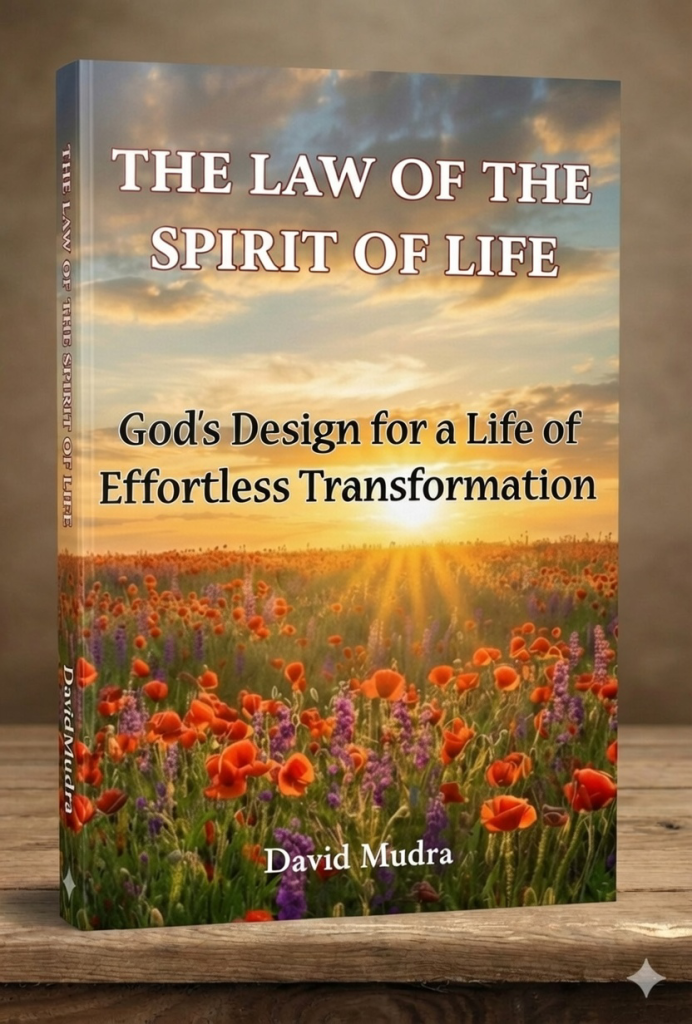
THE LAW OF THE SPIRIT OF LIFE

INTRODUCTION FROM UPCOMING BOOK RELEASE

Many believers genuinely love God, trust in Christ, and desire to live faithfully—yet still experience an exhausting inner cycle. Confidence one moment, condemnation the next. Peace followed by pressure. Breakthroughs that seem to fade as quickly as they came. The question quietly forms: If Christ truly finished the work, why does life still feel so unstable?

The problem is not God’s faithfulness, nor a lack of sincerity in the believer. The issue is usually a misalignment of understanding—specifically, not knowing where God’s work is already finished, where transformation is still unfolding, and how the finished reality becomes lived experience.

At the new birth, God did something complete, decisive, and irreversible. He did not repair or improve the old inner nature—He recreated the believer’s spirit entirely. Scripture calls this a new creation (2 Corinthians 5:17). This recreated spirit is righteous, holy, and fully accepted in Christ—not progressively, but instantly. Nothing is missing. Nothing is pending. Nothing requires improvement.

Yet while the spirit is finished, the soul is not.

The soul—your mind, will, and emotions—is the arena where that finished spiritual reality is gradually learned, believed, and expressed. This is where most of the Christian struggle occurs. Not because God is distant, but because the soul often continues to operate as if something still needs to be earned, fixed, or activated.

This distinction changes everything.

The Christian life is not the spirit being perfected over time; it is the soul learning to align with what is already perfect. Transformation is not God doing something new to your spirit—it is your soul being renewed by truth until daily life reflects what is already true.

That process is not random, emotional, or unpredictable. God governs life—both natural and spiritual—through reliable spiritual law. Just as physical laws describe how creation functions consistently, spiritual laws describe how God’s finished work is received, expressed, and experienced. These laws do not replace relationship; they protect it by making God’s ways dependable rather than arbitrary.

Faith, then, is not begging God to act, nor straining to make something happen. Faith is alignment—the soul agreeing with what God has already accomplished and learning to live from it. Prayer shifts from pressure to positioning, from pleading to agreement. Growth flows from rest, not striving.

This book is written for believers who want their daily experience to match what Scripture declares is already theirs in Christ. It is for those who sense that the gospel must be better news than constant effort, and that grace must be more powerful than religious self-management.

The central claim of this book is simple and foundational:

God finished the believer’s spirit at the new birth; the Christian life is the soul learning to align with that finished reality through reliable spiritual law until daily experience reflects what is already true.

Everything that follows unfolds from this truth.

We will begin by clarifying God’s design and what actually changed at the new birth—who you are now, not who you are trying to become. From there, we will establish the safety of grace and the finality of Christ’s finished work, giving the soul a stable foundation to rest upon. Next, we will explore spiritual law—why life works the way it does—and how faith functions as connection rather than effort. Finally, we will walk through how the soul is renewed in practice and how daily life increasingly aligns with the spirit-led order God designed.

You may notice that certain truths are revisited throughout the book. This is intentional. Deep transformation does not come from hearing something once, but from allowing truth to be reinforced until it becomes the soul’s default reference point. Scripture itself models this pattern—reminding believers of what is already true until belief replaces resistance and rest replaces strain.

The invitation here is not to try harder, but to see more clearly. Not to earn what God has already given, but to learn how to live from it. What God finished in your spirit, He will patiently teach your soul to believe and receive.

This is not an inside-out life built on effort—but on alignment.

Not pressure—but peace.

Not uncertainty—but spiritual order.

Let’s begin by looking at what God has already finished in you.