Many believers genuinely love God, trust in Christ, and desire to live faithfully—yet still experience an exhausting inner cycle. Confidence one moment, condemnation the next. Peace followed by pressure. Breakthroughs that seem to fade as quickly as they came. The question quietly forms: If Christ truly finished the work, why does life still feel so unstable?
The problem is not God’s faithfulness, nor a lack of sincerity in the believer. The issue is usually a misalignment of understanding—specifically, not knowing where God’s work is already finished, where transformation is still unfolding, and how the finished reality becomes lived experience.
At the new birth, God did something complete, decisive, and irreversible. He did not repair or improve the old inner nature—He recreated the believer’s spirit entirely. Scripture calls this a new creation (2 Corinthians 5:17). This recreated spirit is righteous, holy, and fully accepted in Christ—not progressively, but instantly. Nothing is missing. Nothing is pending. Nothing requires improvement.
Yet while the spirit is finished, the soul is not.
The soul—your mind, will, and emotions—is the arena where that finished spiritual reality is gradually learned, believed, and expressed. This is where most of the Christian struggle occurs. Not because God is distant, but because the soul often continues to operate as if something still needs to be earned, fixed, or activated.
This distinction changes everything.
The Christian life is not the spirit being perfected over time; it is the soul learning to align with what is already perfect. Transformation is not God doing something new to your spirit—it is your soul being renewed by truth until daily life reflects what is already true.
That process is not random, emotional, or unpredictable. God governs life—both natural and spiritual—through reliable spiritual law. Just as physical laws describe how creation functions consistently, spiritual laws describe how God’s finished work is received, expressed, and experienced. These laws do not replace relationship; they protect it by making God’s ways dependable rather than arbitrary.
Faith, then, is not begging God to act, nor straining to make something happen. Faith is alignment—the soul agreeing with what God has already accomplished and learning to live from it. Prayer shifts from pressure to positioning, from pleading to agreement. Growth flows from rest, not striving.
This book is written for believers who want their daily experience to match what Scripture declares is already theirs in Christ. It is for those who sense that the gospel must be better news than constant effort, and that grace must be more powerful than religious self-management.
The central claim of this book is simple and foundational:
God finished the believer’s spirit at the new birth; the Christian life is the soul learning to align with that finished reality through reliable spiritual law until daily experience reflects what is already true.
Everything that follows unfolds from this truth.
We will begin by clarifying God’s design and what actually changed at the new birth—who you are now, not who you are trying to become. From there, we will establish the safety of grace and the finality of Christ’s finished work, giving the soul a stable foundation to rest upon. Next, we will explore spiritual law—why life works the way it does—and how faith functions as connection rather than effort. Finally, we will walk through how the soul is renewed in practice and how daily life increasingly aligns with the spirit-led order God designed.
You may notice that certain truths are revisited throughout the book. This is intentional. Deep transformation does not come from hearing something once, but from allowing truth to be reinforced until it becomes the soul’s default reference point. Scripture itself models this pattern—reminding believers of what is already true until belief replaces resistance and rest replaces strain.
The invitation here is not to try harder, but to see more clearly. Not to earn what God has already given, but to learn how to live from it. What God finished in your spirit, He will patiently teach your soul to believe and receive.
This is not an inside-out life built on effort—but on alignment.
Not pressure—but peace.
Not uncertainty—but spiritual order.
Let’s begin by looking at what God has already finished in you.
Let’s unpack Daniel’s Prophecy of the Seventy Weeks—because this might be the most complex and most debated timeline in all of Scripture, and it’s way too easy to get lost in the math and miss the heartbeat of the message.
When most of us hear “70 weeks,” we immediately start doing mental calculations. We’re talking about 490 years. And the traditional approach often slices that timeline up, then pushes the 70th week far into the future—reserved for a future tribulation and the rise of someone labeled the Antichrist. That’s the default framework for a lot of people.
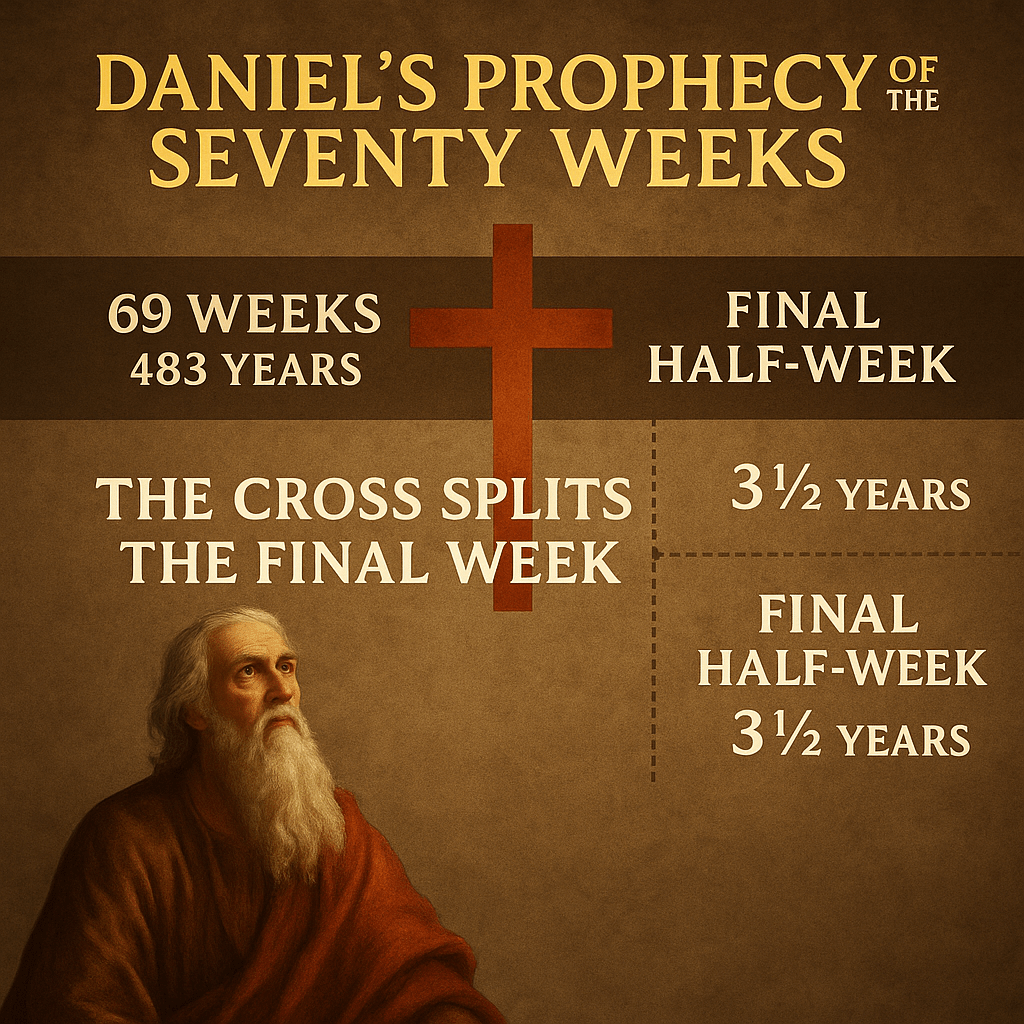
But what you’re laying out is a major paradigm shift. The prophecy isn’t primarily about the triumph of evil, or a massive gap in time, or a future political monster. It’s fundamentally about Christ’s completed work—Christ as the covenant keeper. And here’s the big claim: the cross doesn’t merely appear inside the prophecy. The cross splits the final week right down the middle.
To see why this matters, we have to start with Daniel himself. He’s not sitting in comfort, mapping out futuristic chaos like a prophecy engineer. He’s in Babylon, in exile, deep inside the capital of captivity. He’s distraught. He’s reading Jeremiah. He realizes the 70 years of exile are nearly over—and he prays with desperate hope.
He isn’t hunting secret codes. He’s looking for proof of God’s faithfulness when everything looks like ruin.
And his prayer in Daniel 9 says exactly that. He appeals to God as the great and dreadful God who keeps covenant and mercy. That’s verse 4. Daniel is basically holding God to God’s own promise—despite Israel having completely broken their side of the covenant. Daniel knows God is faithful even when his people are not.
Then Gabriel shows up with an answer to that covenant-focused prayer: a highly specific prophetic timetable. And right there in verse 24, Gabriel gives six objectives. And this is where your Messiah-centered reading becomes so compelling.
Because if this prophecy were mainly about a future political tyrant, you’d expect language about military power, geopolitics, and empire-building.
But that’s not what we get.
We get cosmic, redemptive goals:
to finish the transgression
to make an end of sins
to make reconciliation for iniquity
to bring in everlasting righteousness
Let’s slow down and be honest. What human ruler can “finish the transgression”? That isn’t political reform. That’s a definitive solution to the root problem of sin and rebellion. No king can accomplish that. No treaty can achieve that. That’s God-level work.
And “everlasting righteousness”? Sure, a human leader might enforce temporary law and order. But only the Anointed One can bring righteousness that lasts forever.
So the focus shifts: this stops looking like a prophecy about future political chaos and starts reading like a declaration of Messiah-driven redemption.
Then the timeline narrows in. Gabriel says that after 69 weeks—483 years—“Messiah the Prince” comes. That’s verse 25. Then the Messiah is “cut off, but not for himself.” That’s verse 26. So the prophecy places the death of the Messiah after the 69th week.
And now we hit the controversy: Daniel 9:27.
Traditional readings usually argue that since the Messiah is cut off after the 69th week, there must be a vast time gap between week 69 and week 70—the so-called great parenthesis. And in that view, the “he” in verse 27 becomes a different figure altogether: a future Antichrist who makes a seven-year political covenant with Israel, triggering the tribulation.
But your argument pushes back hard, and your counterpoint is surprisingly simple: Hebrew grammar.
The subject in verse 26 is the Messiah—the one who is cut off. So why assume a brand-new, unnamed character suddenly hijacks the action in the very next line?
You wouldn’t—at least not without a strong reason.
So the most natural, grammatically faithful reading is that the Messiah remains the subject in verse 27: the Messiah is the one who “confirms the covenant.”
That changes everything.
It implies the 490 years run as a continuous prophetic arc, not a stop-and-start timeline. And it places the Messiah’s ministry and death inside the 70th week.
And if the Messiah is the covenant confirmer, then we have to ask: how does he confirm it?
Not with a political peace treaty.
In your framing, this confirmation is done with blood. The thought jumps straight to the Last Supper: “This cup is the New Testament in my blood.” The Messiah ratifies the new covenant with his sacrifice.
Under this framework, the 70th week begins with Christ’s ministry about three and a half years before his death.
Then comes the next crucial phrase in verse 27: “in the midst of the week.”
That means three and a half years into that final seven-year period. And the verse says he will cause sacrifice and offering to cease.
If the Messiah is still the subject, then Christ himself brings the sacrificial system to its ordained conclusion—not by issuing a policy memo, but by making the entire system theologically unnecessary through the once-for-all sacrifice of the cross.
You support this connection to the cross with three strong lines of evidence:
The veil of the temple torn At the moment of Christ’s death, the veil is torn in two from top to bottom (Matthew 27:51). That’s not random symbolism. That’s God announcing that access is now open and the old order has reached its climax.
The shadow-to-substance argument Hebrews describes the old sacrifices as shadows. The moment the true sacrifice arrives—Christ himself—the shadows lose their purpose. Why keep sacrificing animals when the Lamb of God has completed the ultimate sacrifice? Hebrews 10 drives that logic home.
So the message is simple and sharp: the Lamb of God ended the need for lambs of men.
With Christ’s death three and a half years into the 70th week, the new covenant is inaugurated and the need for temple sacrifice is permanently ended.
That means:
69 weeks (483 years) bring us to the Messiah’s arrival.
The first half of the 70th week (3.5 years) brings us to his death.
That’s 486.5 years of fulfillment, with the cross as the hinge of redemptive history.
So what about the remaining half-week?
Here’s your conclusion: a final, unfulfilled prophetic half-week remains. That’s three and a half years—also described as 1260 days, or “time, times, and half a time.”
And that has huge implications for how people think about the tribulation.
In the traditional model, the future tribulation is a full seven years. Under your Messiah-centric model, the future period is cut in half immediately. If Christ fulfills the covenant confirmation and ends sacrifice at the midpoint of the week, then the future period of final judgment and redemption aligns with the remaining three and a half years.
And that shorter timeframe fits the recurring apocalyptic numbers in Revelation: 1260 days, 42 months—especially in chapters 11, 12, and 13.
So, in this view, the 70th week is neither entirely future nor entirely past. It’s divided by the cross. The Messiah claims the first half through his ministry and sacrifice. The church age follows. And history will eventually see the completion of the final half-week by God’s sovereign appointment, particularly in God’s final dealings with Israel and the world.
All of this loops back to the emotional engine of Daniel 9.
Daniel starts in exile, praying for covenant faithfulness in the shadow of judgment. And God answers with a prophecy that doesn’t merely promise restoration—it promises covenant fulfillment enacted by God himself.
So this reading pushes Daniel 9 away from being a scary chronicle of future chaos and back toward being what it may have always been: a Messiah-centered declaration that God finishes what he begins.
And your summary of the Messiah’s four key actions in this prophecy lands cleanly:
He appears.
He is cut off.
He confirms the covenant.
He brings sacrifice to an end.
In that light, Daniel 9 becomes less a cryptic puzzle and more a Christ-centered roadmap.
And it leaves the listener with a haunting, thoughtful question: If the first half-week completed the sacrificial inauguration of the new covenant—finalizing reconciliation and ending the need for sacrifice—what specific divine purposes must unfold within the final, shortened three and a half years?
What completion is left when the covenant itself is already secured?
That’s the weight of the remaining half-week. That’s the tension the prophecy invites you to sit with.Let’s unpack Daniel’s Prophecy of the Seventy Weeks—because this might be the most complex and most debated timeline in all of Scripture, and it’s way too easy to get lost in the math and miss the heartbeat of the message.
When most of us hear “70 weeks,” we immediately start doing mental calculations. We’re talking about 490 years. And the traditional approach often slices that timeline up, then pushes the 70th week far into the future—reserved for a future tribulation and the rise of someone labeled the Antichrist. That’s the default framework for a lot of people.
But what you’re laying out is a major paradigm shift. The prophecy isn’t primarily about the triumph of evil, or a massive gap in time, or a future political monster. It’s fundamentally about Christ’s completed work—Christ as the covenant keeper. And here’s the big claim: the cross doesn’t merely appear inside the prophecy. The cross splits the final week right down the middle.
To see why this matters, we have to start with Daniel himself. He’s not sitting in comfort, mapping out futuristic chaos like a prophecy engineer. He’s in Babylon, in exile, deep inside the capital of captivity. He’s distraught. He’s reading Jeremiah. He realizes the 70 years of exile are nearly over—and he prays with desperate hope.
He isn’t hunting secret codes. He’s looking for proof of God’s faithfulness when everything looks like ruin.
And his prayer in Daniel 9 says exactly that. He appeals to God as the great and dreadful God who keeps covenant and mercy. That’s verse 4. Daniel is basically holding God to God’s own promise—despite Israel having completely broken their side of the covenant. Daniel knows God is faithful even when his people are not.
Then Gabriel shows up with an answer to that covenant-focused prayer: a highly specific prophetic timetable. And right there in verse 24, Gabriel gives six objectives. And this is where your Messiah-centered reading becomes so compelling.
Because if this prophecy were mainly about a future political tyrant, you’d expect language about military power, geopolitics, and empire-building.
But that’s not what we get.
We get cosmic, redemptive goals:
to finish the transgression
to make an end of sins
to make reconciliation for iniquity
to bring in everlasting righteousness
Let’s slow down and be honest. What human ruler can “finish the transgression”? That isn’t political reform. That’s a definitive solution to the root problem of sin and rebellion. No king can accomplish that. No treaty can achieve that. That’s God-level work.
And “everlasting righteousness”? Sure, a human leader might enforce temporary law and order. But only the Anointed One can bring righteousness that lasts forever.
So the focus shifts: this stops looking like a prophecy about future political chaos and starts reading like a declaration of Messiah-driven redemption.
Then the timeline narrows in. Gabriel says that after 69 weeks—483 years—“Messiah the Prince” comes. That’s verse 25. Then the Messiah is “cut off, but not for himself.” That’s verse 26. So the prophecy places the death of the Messiah after the 69th week.
And now we hit the controversy: Daniel 9:27.
Traditional readings usually argue that since the Messiah is cut off after the 69th week, there must be a vast time gap between week 69 and week 70—the so-called great parenthesis. And in that view, the “he” in verse 27 becomes a different figure altogether: a future Antichrist who makes a seven-year political covenant with Israel, triggering the tribulation.
But your argument pushes back hard, and your counterpoint is surprisingly simple: Hebrew grammar.
The subject in verse 26 is the Messiah—the one who is cut off. So why assume a brand-new, unnamed character suddenly hijacks the action in the very next line?
You wouldn’t—at least not without a strong reason.
So the most natural, grammatically faithful reading is that the Messiah remains the subject in verse 27: the Messiah is the one who “confirms the covenant.”
That changes everything.
It implies the 490 years run as a continuous prophetic arc, not a stop-and-start timeline. And it places the Messiah’s ministry and death inside the 70th week.
And if the Messiah is the covenant confirmer, then we have to ask: how does he confirm it?
Not with a political peace treaty.
In your framing, this confirmation is done with blood. The thought jumps straight to the Last Supper: “This cup is the New Testament in my blood.” The Messiah ratifies the new covenant with his sacrifice.
Under this framework, the 70th week begins with Christ’s ministry about three and a half years before his death.
Then comes the next crucial phrase in verse 27: “in the midst of the week.”
That means three and a half years into that final seven-year period. And the verse says he will cause sacrifice and offering to cease.
If the Messiah is still the subject, then Christ himself brings the sacrificial system to its ordained conclusion—not by issuing a policy memo, but by making the entire system theologically unnecessary through the once-for-all sacrifice of the cross.
You support this connection to the cross with three strong lines of evidence:
The veil of the temple torn At the moment of Christ’s death, the veil is torn in two from top to bottom (Matthew 27:51). That’s not random symbolism. That’s God announcing that access is now open and the old order has reached its climax.
The shadow-to-substance argument Hebrews describes the old sacrifices as shadows. The moment the true sacrifice arrives—Christ himself—the shadows lose their purpose. Why keep sacrificing animals when the Lamb of God has completed the ultimate sacrifice? Hebrews 10 drives that logic home.
So the message is simple and sharp: the Lamb of God ended the need for lambs of men.
With Christ’s death three and a half years into the 70th week, the new covenant is inaugurated and the need for temple sacrifice is permanently ended.
That means:
69 weeks (483 years) bring us to the Messiah’s arrival.
The first half of the 70th week (3.5 years) brings us to his death.
That’s 486.5 years of fulfillment, with the cross as the hinge of redemptive history.
So what about the remaining half-week?
Here’s your conclusion: a final, unfulfilled prophetic half-week remains. That’s three and a half years—also described as 1260 days, or “time, times, and half a time.”
And that has huge implications for how people think about the tribulation.
In the traditional model, the future tribulation is a full seven years. Under your Messiah-centric model, the future period is cut in half immediately. If Christ fulfills the covenant confirmation and ends sacrifice at the midpoint of the week, then the future period of final judgment and redemption aligns with the remaining three and a half years.
And that shorter timeframe fits the recurring apocalyptic numbers in Revelation: 1260 days, 42 months—especially in chapters 11, 12, and 13.
So, in this view, the 70th week is neither entirely future nor entirely past. It’s divided by the cross. The Messiah claims the first half through his ministry and sacrifice. The church age follows. And history will eventually see the completion of the final half-week by God’s sovereign appointment, particularly in God’s final dealings with Israel and the world.
All of this loops back to the emotional engine of Daniel 9.
Daniel starts in exile, praying for covenant faithfulness in the shadow of judgment. And God answers with a prophecy that doesn’t merely promise restoration—it promises covenant fulfillment enacted by God himself.
So this reading pushes Daniel 9 away from being a scary chronicle of future chaos and back toward being what it may have always been: a Messiah-centered declaration that God finishes what he begins.
And your summary of the Messiah’s four key actions in this prophecy lands cleanly:
He appears.
He is cut off.
He confirms the covenant.
He brings sacrifice to an end.
In that light, Daniel 9 becomes less a cryptic puzzle and more a Christ-centered roadmap.
And it leaves the listener with a haunting, thoughtful question: If the first half-week completed the sacrificial inauguration of the new covenant—finalizing reconciliation and ending the need for sacrifice—what specific divine purposes must unfold within the final, shortened three and a half years?
What completion is left when the covenant itself is already secured?
That’s the weight of the remaining half-week. That’s the tension the prophecy invites you to sit with.
God designed us to live from the inside out—spirit first, then soul, then body—and His Word is the food that keeps that whole system alive and healthy. When we ignore that order, everything starts to wobble: our thoughts, our emotions, even our physical strength. When we honor it, life begins to feel aligned again, like a machine finally running the way its Maker intended.
Scripture shows that we are not just a body with some vague “inner life.” Paul writes, “I pray God your whole spirit and soul and body be preserved blameless” (1 Thessalonians 5:23). That’s not random wording. It suggests a clear structure: spirit, then soul, then body. The spirit is the deepest part of you—the real “you,” where you are aware of God, where you sense and know things that go beyond logic (Romans 8:16). When someone is born again, that spirit is made new, righteous, and united with the Holy Spirit. The soul sits in the middle and includes your mind, will, and emotions—the part of you that thinks, chooses, and feels. The body is your visible, physical shell, the way you show up and act in the world.
The Bible even tells us that God’s Word can reach into these layers and separate them in a way nothing else can. Hebrews 4:12 says the Word of God is so sharp it can divide soul and spirit, “joints and marrow.” In other words, it can cut right down into the deepest places and show what’s happening where. Only God’s Word can do that, because only God’s Word is designed to feed and sort out those different parts in the right order.
Just like your body needs food, your spirit needs food—and not just occasionally. Jesus said, “Man shall not live by bread alone, but by every word that proceeds out of the mouth of God” (Matthew 4:4). Bread keeps the body going; God’s Word feds the spirit and quickens our souls. Peter compares believers to newborn babies who should crave “the sincere milk of the word” so they can grow (1 Peter 2:2). No food, no growth. That’s true physically, and Scripture says it’s just as true spiritually.
Job understood this long before any of us. He said he valued God’s words more than his necessary food (Job 23:12). He saw that real life is not just about keeping the body going; it’s about feeding the spirit. Jesus agreed: “The words that I speak unto you, they are spirit, and they are life” (John 6:63). God’s Word is spiritual in nature and life-giving in effect. When your spirit takes it in, something living is happening, even when you don’t feel anything dramatic.
Now think about what happens when you don’t eat. When the body goes without food, it gets weak, tired, and shaky. You feel faint, you can’t focus, and your emotions often sink. Scripture uses that picture to help us understand what happens on the inside when we neglect spiritual food. David described his inner dryness this way: when he kept silent and held things in before God, he said his bones felt like they were aging and his strength was gone “as in the drought of summer” (Psalm 32:3–4). His spiritual condition was affecting his physical and emotional state.
Proverbs gives the same idea in a sentence: “A broken spirit drieth the bones,” but “a merry heart doeth good like a medicine” (Proverbs 17:22). When the spirit is crushed, the body feels it. When the inner life is joyful, it’s like medicine to the whole person. God built us so that what happens in the spirit eventually touches the soul and finally shows up in the body. This is not an accident. God designed life to flow from the deepest part of us outward.
When the spirit is fed with the Word of God, the first place the effects show up is in the soul—how we think, feel, and choose. Scripture renews the mind, which is part of the soul. Paul says, “Be transformed by the renewing of your mind” (Romans 12:2). And what is the benefit of that? The passage goes on to say that you will prove that God’s will is good, perfect and acceptable!
The Word doesn’t just give us new ideas; it reshapes how we see reality. It also brings peace to the heart: “Great peace have they which love thy law” (Psalm 119:165). Love the Word, and peace follows. Jeremiah said, “Thy word was unto me the joy and rejoicing of mine heart” (Jeremiah 15:16). Joy doesn’t begin in the emotions; it starts with the Word reaching the spirit and then flowing out into the feelings. David could say, “He restoreth my soul” (Psalm 23:3), because God’s truth reaches weary, damaged places inside and brings them back to life.
So the chain looks like this: the Word strengthens the spirit, the strengthened spirit renews the soul, and then both begin to affect the body and even the physical world around you. Paul describes it like this: that God would strengthen us “with might by his Spirit in the inner man” (Ephesians 3:16). The Holy Spirit uses the Word to empower the “inner man”—your spirit. That inner strength then shows up in clearer thinking, better attitudes, steadier emotions, and wiser choices.
From there, Scripture shows that the body is not left out of the process. What is planted in the heart eventually appears in how we live, act, and even in our health. Solomon urges his son to pay attention to God’s words and keep them in his heart because “they are life unto those that find them, and health to ALL their flesh” (Proverbs 4:20–22). Notice the order: the Word enters, settles in the heart, and then becomes life and health to the body. It’s inside → outside every time.
John echoes this when he says, “I wish above all things that thou mayest prosper and be in health, even as thy soul prospereth” (3 John 2). The prosperity and health he longs for are tied to the condition of the soul. God’s pattern is consistent: the state of your inner life sets the tone for your outer life.
Put simply, God designed spirit, soul, and body to work as a team—with the spirit leading, not trailing behind. The Spirit of God lives in the believer’s spirit and produces fruit—love, joy, peace, and so on (Galatians 5:22–23). But for that fruit to shape the rest of life, the spirit must be fed. When the spirit is nourished by the Word, the soul is refreshed, reordered, and stabilized. Then the body is guided and strengthened by that inner overflow instead of being driven purely by feelings or circumstances.
Ignore spiritual food, and the results are predictable: weakness, confusion, lack of stability, and reduced capacity to handle life. Feed the spirit, and you see the opposite: strength, clarity, peace, and steadiness. This isn’t a motivational slogan; it’s the order of creation as Scripture reveals it.
Finally, Jesus ties all of this to the renewing of the mind and to trusting Him. A renewed mind is not a luxury; it’s how we learn to recognize God’s will and walk in spiritual strength (Romans 12:2). When Jesus says, “Man shall live by every word of God” (Matthew 4:4), He is not giving a poetic line; He is telling us how human beings actually live as God intended. To believe Him is to take that seriously.
So if Jesus tells us that His Word brings blessing, peace, and spiritual vitality, then valuing mind renewal is really a way of saying, “I trust You, Lord.” Feeding the spirit with the Word becomes an act of faith, not just a habit. We feed on His Word because we believe what He says. We renew our minds because He has told us this will transform us. And we seek the health of spirit, soul, and body because that is how God made us to function: life starting in the spirit, moving through the soul, and reaching all the way out to the body.
2 Peter 3:8 isn’t just a comforting verse about God being “outside of time.” Peter drops it right in the middle of an end-times conversation, answering people who were already asking, “Where is the promise of His coming?” He describes the Day of the Lord, the final judgment, the destruction and renewal of the world—and in that context he says, “With the Lord one day is as a thousand years, and a thousand years as one day.” That sounds less like a random poetic flourish and more like a key: if God sometimes chooses to “think” in thousand-year blocks that He calls “days,” then maybe the Creation week itself is a map of how long human history will run before that Day arrives. [Inference]
Imagine time itself as a seven-day week on God’s calendar. The first “day” begins with Adam walking out of Eden into a world that suddenly feels heavy: sweat on his forehead, thorns in the ground, death now part of the story. Humanity spreads, falls deeper into violence, reaches the days of Noah and the flood, then stumbles toward Babel, where God scatters the nations. That long, rough stretch from Adam to Abraham covers about two thousand years in many traditional chronologies—one thousand-year “day,” then another. The third “day” begins when God calls Abraham and starts working not just with humanity in general but with one particular family that will become one particular nation. For roughly another two thousand years, through patriarchs and prophets, judges and kings, exile and return, God writes His promises into the life of Israel. The Law is given, sacrifices are offered, feasts are kept, and the prophets keep pointing forward to Someone who is coming. By the time Jesus appears, you’ve moved through four thousand years—four great “days” of a thousand years each—of preparation. [Inference]
Now freeze the frame at the cross. If you treat the end of the fourth “day” as the death and resurrection of Jesus around the year 30, the timing suddenly sharpens. On that Passover in 30 AD, the fourth day closes: all the shadows and symbols of the previous four thousand years collide on one hill outside Jerusalem. The true Lamb is sacrificed, the true High Priest intercedes, the true Temple presence is unveiled as the curtain tears. From God’s point of view, four vast “days” have been marching toward this single weekend. When Jesus cries, “It is finished,” the age of preparation ends, and the fifth “day” begins not at His birth, not at Pentecost, but at the moment His blood seals the new covenant. [Speculation]
If one prophetic “day” is a thousand years, that fifth day runs from about year 30 to 1030, and the sixth day from about 1030 to 2030. That puts us living at the fading edge of the sixth day, watching the sun slide toward the horizon. We are not just generically “in the last days” the way every generation has been since the apostles; on this view, we are about at the end of the sixth thousand years of human history, standing near the boundary between the work-week of the world and the Sabbath of the world. No one can nail the exact year, and the biblical warnings against setting dates still stand untouched, which is why that little word “about” matters so much. But measured from the cross in year 30 as the end of the fourth “day,” two more thousand-year “days” bring you right into our century. [Speculation]
This idea isn’t a clever modern internet chart; it’s an old story. In the Talmud, some Jewish rabbis taught that the world would last six thousand years and then enter a thousand-year “Sabbath,” echoing God’s six days of work and one day of rest. They even divided those six thousand years into broad eras: two thousand years of “chaos” or “desolation” before Abraham, two thousand years of Torah and Israel’s special calling, and two thousand years linked with the days of Messiah. [Inference] Early Christians picked up the same pattern. A second-century work called the Epistle of Barnabas explicitly connects the six days of creation with six thousand years of history and says that the seventh day foreshadows a thousand-year reign of Christ. The church father Irenaeus, also in the second century, argued similarly: just as the world was made in six days, so it would run for six thousand years, with a seventh thousand-year kingdom as its Sabbath. Later writers like Hippolytus echoed the same scheme. For them, 2 Peter 3:8 wasn’t just reassurance that God is patient; it was a Spirit-given hint that those “days” in Genesis could be read as thousand-year blocks leading up to the kingdom. [Inference]
Seen like this, Peter’s strange sentence in 2 Peter 3:8 feels less random and more surgical. He’s addressing people who are tempted to mock the apparent delay of Christ’s return: “Where is this coming He promised?” His answer is not, “Relax, it’s symbolic, He’ll never actually come,” but the exact opposite: the Day of the Lord will come; the heavens will pass away with a roar; the earth will be exposed; new heavens and a new earth are waiting. Right in the middle of that, he says, “Don’t forget this one thing: with the Lord one day is as a thousand years…” It’s as if the Spirit is saying, “If you only count by your own little clock, you’ll misread the delay. God is working on a week-long scale you haven’t fully grasped.” That’s where the Creation pattern and the thousand-year “days” snap together: six days of labor, one day of rest; six thousand years of human history under the curse and the cross, one thousand years of visible, righteous rule under Christ. [Inference]
Does this mean we can mark our calendars and circle a date? Absolutely not. Peter warns in the same chapter that the Day of the Lord will come like a thief, and Jesus Himself said no one knows the day or the hour. The point of this six-days-then-Sabbath picture isn’t to make us smug chart-keepers; it’s to make us sober, awake servants. If four prophetic “days” carried the world from Adam to the cross and two more have nearly carried it from the cross to now, then we are living, by this way of seeing, in the late afternoon of the sixth day. That’s not a reason to speculate endlessly; it’s a reason to live differently. If the week is almost over, do you really want to spend the last hours scrolling, drifting, and arguing, or do you want to be found faithful when the sun finally sets and the great Sabbath begins? [Speculation]
In that light, the entire sweep of history starts to look like a story written around one Person. Four thousand years, four “days,” preparing the stage for Jesus’ death and resurrection around year 30; two thousand more years, two “days,” sending the news of that victory to every tribe and tongue; and then, at the edge of the sixth day, the world waiting for the curtain to rise on the seventh: a thousand years when Christ reigns and the earth finally breathes. Whether God chooses to align the end precisely with our calendars or not, the pattern itself is powerful. It says history is not a random loop; it’s a measured week. And if 2 Peter 3:8 is indeed the key that unlocks that pattern, then we are not just reading about the end times—we are living very near the end of the sixth day.
It’s honestly amazing when you stop and think about it — the blood of Jesus doesn’t just do one thing. It’s not just forgiveness or redemption; it’s seven powerful, life-changing gifts poured into your life through one act of love. The Bible describes the blood of Christ like a divine key that has unlocked every door between you and God. It didn’t just wipe away your past — it gives you a new standing, a new peace, and even a new kind of power. The more you understand what His blood has done for you, the more you realize you’re living under a miracle.
First, His blood brings forgiveness. Every one of us has made choices that left scars — on others, on ourselves, and on our relationship with God. But when Jesus shed His blood, He paid the full cost of every wrong. Scripture says, “In Him we have redemption through His blood, the forgiveness of sins, in accordance with the riches of God’s grace” (Ephesians 1:7). There’s no “sin too big” clause, no fine print. Forgiveness through His blood isn’t partial or probationary; it’s complete. It doesn’t ask you to earn your way back to God. It simply says, “You’re free.”
Then comes cleansing — that deep, inner healing no human therapy can reach. You can be forgiven and still feel unclean, but the blood of Jesus washes more than your record; it washes your conscience. The Bible reminds us that “the blood of Jesus Christ His Son cleanses us from all sin” (1 John 1:7) and that “the blood of Christ… cleanses your conscience from dead works to serve the living God” (Hebrews 9:14). His blood takes away the inner voice that says, “You’ll never be good enough,” and replaces it with the quiet assurance, “You’re Mine.” The blood silences shame and lets you breathe again.
His blood also brings justification, which means you’re not just forgiven — you’re declared righteous. Picture standing before a judge who looks at every charge against you, then stamps your case “closed” because Jesus already took the sentence. “Since we have now been justified by His blood, how much more shall we be saved from God’s wrath through Him!” (Romans 5:9). You walk out of that courtroom not as a criminal but as someone in right standing with God. That’s more than mercy; that’s grace.
Then there’s redemption. Humanity sold itself into slavery to sin, but the blood of Jesus became the ransom that set us free. As Peter wrote, “You were not redeemed with corruptible things, like silver or gold… but with the precious blood of Christ, as of a lamb without blemish and without spot” (1 Peter 1:18–19). He didn’t just open the cell door; He paid for your release with His own life. Your worth isn’t tied to what you’ve done wrong but to what He thought you were worth dying for.
His blood also gives peace with God. Sin once made us strangers to Him, but the blood turned enemies into family. The cross wasn’t just about punishment; it was about reconciliation — restoring a broken relationship. “Having made peace through the blood of His cross, by Him to reconcile all things unto Himself” (Colossians 1:20). That peace isn’t fragile or conditional; it’s settled forever.
And now, because of that same blood, we have access to God’s presence. In the Old Testament, only one priest could enter the Most Holy Place once a year. But when Jesus died, the temple curtain ripped in two from top to bottom — God’s way of saying, “Come on in.” Scripture tells us, “We have confidence to enter the Most Holy Place by the blood of Jesus” (Hebrews 10:19). Through His blood, you can talk to God anytime, anywhere — no barriers, no rituals, no waiting your turn.
Finally, His blood gives victory. The same blood that forgave you also disarms the enemy. “They overcame him by the blood of the Lamb and by the word of their testimony” (Revelation 12:11). That means when fear, guilt, or temptation come knocking, you can stand your ground because the blood of Jesus already declared the outcome — victory.
So yes, it’s staggering to realize — seven different ways, one single sacrifice. His blood forgives, cleanses, justifies, redeems, reconciles, opens, and conquers. Every drop tells a story of love so powerful that it rewrote history — and yours too. When you really see what His blood has done, you can’t help but stand in awe.
Imagine cutting your hand on a sharp edge. Without a single conscious thought, your body launches into action. Blood rushes to the site, and platelets gather like tiny engineers constructing a dam. They form a clot, a natural bandage sealing the wound. Beneath this protective scab, a symphony unfolds—skin cells multiply, collagen weaves itself into the fabric of your dermis, and new tissue forms. Days pass, and the scab falls away, leaving your skin whole again. This quiet, miraculous process happens every time you’re injured. You don’t command it. You barely notice it. And yet, your body knows exactly what to do.
Psalm 139:14 declares, “I praise You because I am fearfully and wonderfully made.” In Hebrew, yare (fearfully) speaks of awe and reverence, as if beholding something so intricate and extraordinary that it inspires trembling wonder. Palah (wonderfully) means to be set apart, unique, and beyond comprehension. These words capture the marvel of what your body does every single day.
Consider regeneration—the quiet renewal happening every moment. Your skin, the body’s largest organ, sheds and replaces about 30,000 cells every minute, creating a new layer every month. Beneath the surface, your bones are also renewing. They’re constantly breaking down and rebuilding themselves, so your skeleton is effectively replaced every decade. Your liver? This overachieving organ can regenerate up to 75% of its mass if damaged. Even your stomach lining, exposed daily to harsh acids, renews itself every few days. Every part of you is designed to repair, renew, and adapt, as if guided by an unseen hand.
Your brain is no exception. Neuroplasticity, the brain’s ability to rewire itself, allows you to adapt to injury or learn new skills. When one pathway is damaged, new connections can form, helping you recover lost functions or develop new abilities. Your brain isn’t just an organ; it’s a dynamic, ever-evolving network of possibility.
And then there’s your immune system—a tireless, unseen guardian. White blood cells patrol your body, identifying and destroying invaders like viruses and bacteria. But the immune system doesn’t work alone. The lymphatic system, a vast network of vessels and nodes, drains excess fluid, filters out toxins, and supports your immune response. Together, these systems keep you healthy, often without you realizing they’re at work.
Even your reflexes show how your body is constantly looking out for you. Touch something hot, and your hand pulls away before your brain even registers the burn. This lightning-fast reaction is your reflex arc, bypassing the brain to protect you instantly.
Your body’s adaptability is another wonder. Your eyes, for instance, automatically adjust to light and dark, dilating and contracting your pupils to protect your vision. If they get dry, tears flow to lubricate and cleanse them. Your ears? Tiny muscles dampen loud sounds to prevent damage, while your inner ear fluid keeps you balanced, even when you move suddenly.
And what about saliva? This humble fluid doesn’t just moisten your mouth; it begins digestion, protects your teeth from decay, and keeps your mouth free of bacteria. Even something as mundane as swallowing is a choreographed dance of dozens of muscles working together in perfect harmony.
Temperature regulation is yet another marvel. When you’re too hot, sweat glands activate to cool you down through evaporation. When you’re cold, your body shivers—tiny, involuntary muscle contractions that generate heat. This delicate balance keeps your core temperature stable, enabling you to thrive in diverse environments.
Even your microbiome—the trillions of bacteria living in your gut—is part of this grand design. These microbes help digest food, produce vital nutrients, regulate your immune system, and even influence your mood. They’re tiny partners in the incredible ecosystem that is your body.
And let’s not forget your heart and lungs. Your heart beats around 100,000 times a day, pumping blood through 60,000 miles of vessels. Every minute, your blood completes a full circuit of your body, delivering oxygen and nutrients to every cell. Meanwhile, your lungs oxygenate your blood while tiny cilia sweep away debris, keeping your airways clear.
All these processes happen without your conscious effort. Your body is a masterpiece of resilience and design. You are not just alive; you are thriving, thanks to the incredible systems working tirelessly behind the scenes.
“You are fearfully and wonderfully made.” Pause and reflect on that. Every blink, every heartbeat, every breath is a testament to the wisdom and care that went into your creation. You are not ordinary. You are a living, breathing miracle. Isn’t that breathtaking?
“All of humanity’s problems stem from man’s inability to sit quietly in a room alone.” this is one of my favorite quotes which. Blaise Pascal said centuries ago, and somehow, it feels even more true today. Think about it—how often do you reach for your phone the moment you’re bored? Why is it so uncomfortable to just sit still, alone with your thoughts? Pascal believed the answer wasn’t just about habit—it was about avoiding the truth.
He argued that when we sit quietly and step away from distractions, we’re forced to confront life’s deepest questions: What’s my purpose? Am I truly happy? Am I at peace with God? And let’s be honest—those questions can be intimidating. So instead, we distract ourselves. We dive into work, entertainment, and social media, anything to avoid the silence. But does it really work? Pascal didn’t think so, and the Bible agrees.
Paul says in Romans 1:18-20 that the truth about God is plain to us—His power and divine nature are clear in the world around us. But here’s the catch: people suppress that truth. Why? Because facing it means reckoning with who we are and how much we depend on God. That’s uncomfortable, so we run from it, filling our lives with noise and busyness instead.
Yet Scripture consistently shows that the solution isn’t more distractions; it’s stillness. In Psalm 46:10, God says, “Be still, and know that I am God.” Stillness allows us to see reality clearly—not just who God is, but who we are in relation to Him. And Jesus modeled this perfectly. Over and over in the Gospels, we see Him retreating to quiet places to pray, like in Matthew 14:23, where He went alone to a mountainside after a long day of ministry. If even Jesus needed time alone with the Father, how much more do we?
But solitude isn’t just about rest; it’s also transformative. In Lamentations 3:28-29, the writer encourages us to “sit alone in silence, for the Lord has laid it on him… there may yet be hope.” Sitting quietly forces us to face our pride, our sins, and our fears, but it also opens the door to humility, hope, and renewal.
Pascal’s insights also tie directly to Jesus’ teaching in Matthew 16:25: “Whoever wants to save their life will lose it, but whoever loses their life for me will find it.” Losing your life, in this sense, means letting go of the superficial self—the one that clings to comfort, distractions, and worldly success. When we lose that part of ourselves and embrace the truth, we find real life: peace with God and purpose in Him.
The problem is, distractions come with a cost. Pascal warned that diversions aren’t just innocent time-fillers—they’re a way to avoid dealing with life’s big questions. Jesus put it even more bluntly in John 3:19-20: “Light has come into the world, but people loved darkness instead of light… Everyone who does evil hates the light, and will not come into the light for fear that their deeds will be exposed.” It’s easier to stay busy than to let the truth expose what’s in our hearts. But the more we avoid it, the more restless and anxious we become.
So, what’s the way forward? How do we embrace the kind of solitude that Pascal and Scripture say is essential? Here are a few practical steps: 1. Start Small. Spend just 5-10 minutes a day sitting quietly. Use that time to pray or reflect on verses like Psalm 62:1: “Truly my soul finds rest in God; my salvation comes from him.” 2. Turn Off the Noise. Create boundaries with your phone and social media. Try sitting alone without reaching for a screen or filling the space with background noise. 3. Ask the Hard Questions. In your quiet moments, be honest with yourself: What truths am I avoiding? What distractions are keeping me from God? 4. Follow Jesus’ Example. Make time regularly to step away from the chaos of life. Jesus often retreated to solitary places to connect with God—and in those moments, He found strength and clarity.
Pascal’s challenge is simple but profound: Can we sit quietly, alone, and face the truth? Scripture assures us that when we do, we don’t face it alone. God meets us there, in the stillness, offering the peace and purpose we so desperately seek.
So, take a moment. Turn off the noise. Sit in the quiet. It may feel uncomfortable at first, but in losing the distractions, you’ll gain something far greater: the presence of God and the life He created you to live.
Think for a moment about the natural world around us. You know it as well as I do—gravity never fails. If you jump, you will fall. If you plant seeds in good soil, they will grow. If you put your hand in fire, it will burn you. These are not mere guesses or superstitions. These are laws, predictable and unchanging, woven into the very fabric of creation. And just as surely as the natural world is governed by these physical laws, the spiritual realm operates by unshakable spiritual laws.
What many call “commands” in the Bible are not arbitrary rules given by a stern taskmaster; they are God’s loving guidance about these laws. He is not demanding obedience to make life difficult—He is showing us how to avoid harm and experience blessing. When He says, “Don’t do this,” He’s saying, “I see the cliff ahead, and I don’t want you to fall.” When He warns against sin, He’s not withholding something good—He’s steering you away from something that will destroy you. Every spiritual law He reveals is born from a heart that loves us more than we can imagine. This is why you can trust God’s goodness: His laws exist to bless you, protect you, and lead you to the abundant life He intends for you.
Jesus Himself teaches us about these laws. In John 15:7, He says, “If ye abide in me, and my words abide in you, ye shall ask what ye will, and it shall be done unto you.” At first glance, you might think this is a reward—something God gives to the super-spiritual. But Jesus isn’t talking about rewards; He’s showing us how spiritual laws work. Abiding in Him is not a requirement to earn God’s favor—it’s the connection that allows His life to flow into us. Just like gravity pulls a falling object to the ground, abiding in Christ releases the flow of His power, blessings, peace, and favor into your life.
Picture a vine and its branches. The branch doesn’t strain to bear fruit. It doesn’t work hard to prove itself worthy. It simply stays connected to the vine. The vine does the work. The vine provides the life. And as long as the branch remains connected, the flow is constant, and fruit is inevitable. That’s what abiding in Christ looks like. The Holy Spirit—God’s one and only source—flows into you like floodgates wide open. Everything in the vine flows through you: all the blessings, all the favor, all the love, and all the power.
But here’s where things can get tricky. The flow never stops on God’s end. The floodgates are wide open. Yet sometimes, we don’t experience the blessings He intends because we block the flow. Imagine a garden hose, pouring water at full pressure. If you kink the hose, the flow slows to a trickle—or stops altogether. Fear, anxiety, unbelief, and disobedience are the kinks that crimp the flow of the Spirit.
Think about fear for a moment. Fear tightens your grip on the hose. It says, “I don’t trust God to handle this.” Anxiety does the same thing—it’s faith in the wrong direction, trusting that something bad will happen. Unbelief shuts the hose entirely, refusing to trust God’s Word. And disobedience? Disobedience is stepping out of alignment with the flow altogether. God’s Spirit never stops flowing, but we step out from under the blessing when we choose our own way.
Now here’s the good news: you can remove the kinks. God doesn’t ask you to “fix it all” or “work harder”—He simply asks you to trust Him. Replace fear with trust. Replace anxiety with prayer. Replace unbelief with faith. Replace disobedience with alignment to His Word. Every step you take to align yourself with God is like unkinking that hose. The flow of the Spirit begins to rush through you again—bringing peace where there was chaos, joy where there was sorrow, and provision where there was lack.
God’s laws are consistent. They don’t play favorites. Just as gravity will pull anyone down, spiritual laws will work for anyone who abides in Christ and aligns with His ways. The gardener doesn’t scream at the soil to make seeds grow; he simply creates the right conditions. And the seeds grow naturally because of the laws God put into place. The same is true for you: your part is to stay connected and create the right conditions. When you remain in Christ and remove the blockages, the fruit will come naturally, and the fruit isn’t just “spiritual success”; it’s real, tangible change in your life. You’ll experience peace where there was chaos, joy where there was sorrow, and provision where there was lack. God’s blessings will overflow, not only for you but also for those around you.
Faith operates in a similar way. When you speak words, you trigger spiritual laws and create physical changes. Jesus said, “If ye have faith as a grain of mustard seed, ye shall say unto this mountain, Remove hence to yonder place; and it shall remove.” Faith isn’t about striving to prove your spirituality—it’s about aligning your words and actions with God’s spiritual laws that govern all reality. When you release faith through your words, you activate these spiritual laws, and things begin to change.
Let this truth settle deep in your heart: the spiritual realm is not just real—it’s more real than the physical world. The spiritual realm is the birthplace of everything you see, touch, and experience. God spoke, and the universe came into existence. That same spiritual reality governs what happens in your life. When you align yourself with the spiritual laws God has set in motion, you are tapping into the source of all power, all life, and all blessing.
If you jump, you will fall. If you abide, you will bear fruit—fruit that brings supernatural peace, abundant provision, unshakable joy, and overwhelming love. And the best part? This isn’t reserved for a few spiritual elites. It’s available to anyone. The floodgates are open, and the flow of God’s Spirit is constant. All you have to do is stay connected, trust His goodness, and remove the blockages.
Because the laws of the Spirit don’t fail—because God’s love never fails.
Imagine walking into a bustling home filled with the clatter of dishes and the hum of activity. In the kitchen, a woman rushes about, flushed and flustered, trying to keep up with the demands of hosting. But across the room, her sister sits motionless, absorbed, her eyes fixed on their guest. She isn’t helping in the kitchen, cleaning, or preparing. She’s simply sitting—still, attentive, and focused.
This is the scene in Luke 10, when Jesus visits the home of Martha and Mary. Martha’s frustration boils over, and she pleads with Jesus to make Mary help. But His reply is unexpected:“Martha, Martha, thou art careful and troubled about many things: But one thing is needful: and Mary hath chosen that good part, which shall not be taken away from her.”(Luke 10:41–42).
One thing. In a world drowning in demands, distractions, and endless duties, Jesus cuts through the noise and declares there is only one thing we truly need. And Mary found it—not in activity, but in sitting at the feet of Jesus and listening to His Word.
This story isn’t just a quaint moment in the Gospels. It’s a profound lesson for every believer today. The “one thing” Jesus spoke of is the meditation on and devotion to God’s Word—the only thing that truly sustains us.
The Word as Our Spiritual Food
Jesus’ words to Martha are not a dismissal of work or service. Rather, they are a call to prioritize what matters most. The Bible consistently teaches that God’s Word is essential to our lives. Jesus makes this clear in Matthew 4:4:“Man shall not live by bread alone, but by every word that proceedeth out of the mouth of God.”Just as food nourishes our bodies, the Word nourishes our spirits.
But think about it—what happens when you go without eating? Your stomach growls, your energy fades, and eventually, your body begins to shut down. The same is true spiritually. When we neglect the Word of God, we grow weak. Our faith falters, our joy diminishes, and our ability to resist temptation crumbles. Without the Word, we are spiritually starved.
Mary understood this in a way Martha didn’t. Martha was feeding her guests, but Mary was being fed by Jesus’ words. She realized that spiritual food takes precedence over even the most pressing of tasks.
God’s Word is Alive and Transforming
Here’s the thing: the Word of God is not just a collection of ancient texts or moral teachings. It is alive. Hebrews 4:12 declares: “For the word of God is alive, and powerful, and sharper than any twoedged sword.”When we meditate on Scripture, we aren’t simply reading words on a page. We are engaging with the living, breathing truth of God. His Word cuts through confusion, convicts us of sin, and brings clarity to life’s complexities.
Proverbs 4:22 describes the transformative power of God’s words:“For they are life unto those that find them, and health to all their flesh.”The Bible isn’t just informational—it’s transformational. It brings life to our spirits, healing to our bodies, and guidance for our minds.
When we sit with God’s Word—whether reading it, hearing it, or reflecting on it—we open ourselves to His transformative power. It renews our minds, strengthens our hearts, and equips us to face life’s challenges.
The Danger of Neglecting the Word
But as alive as God’s Word is, it won’t transform us if we fail to engage with it. Skipping time in God’s Word is like trying to run a marathon on an empty stomach—you might start strong, but eventually, you’ll collapse. Without the Word, our spiritual strength fades, our faith becomes brittle, and we are left vulnerable to the storms of life.
Neglecting the Word leaves us directionless. It’s no wonder Psalm 1 compares the person who meditates on God’s Word to a tree planted by streams of water—stable, fruitful, and unshakable. The person who ignores it? They are like chaff, blown away by the wind.
Spiritual starvation is subtle at first. You skip a day in the Word, then another. Soon, you find yourself running on empty, your faith dry and brittle. But the good news is this: God’s Word is always ready to restore us. One verse, one moment of meditation, can reignite a fire in your soul.
The One Thing Needed
So, what about us? Are we like Martha, “careful and troubled about many things,” or like Mary, sitting at the feet of Jesus? The truth is, we all live in Martha’s world—a world of deadlines, distractions, and constant demands. But Jesus reminds us that onlyone thingis needful. When we meditate on the Word, everything else falls into its proper place. Our priorities shift, our burdens lighten, and our hearts find rest.
But let’s be honest—if we refuse to do thisone thing,we are, in essence, saying we don’t believe Jesus. We’re declaring that we know better than the One who is the Way, the Truth, and the Life. How can we truly call ourselves believers if we don’t actually do what He has told us is most important?
James 1:22 challenges us with this truth:“But be ye doers of the word, and not hearers only, deceiving your own selves.”If we claim to believe in Jesus, our faith must lead to obedience. To ignore His instruction to prioritize His Word is to live in self-deception, claiming allegiance to Christ while disregarding His authority.
Jesus has made it clear:“One thing is needful.”To reject this is to reject not only His guidance but His lordship over our lives. But to embrace it—to choose the “good part,” as Mary did—is to live in alignment with His will, nourished by the very words of life.
Engage with the Word in Any Form
The question isn’t just whether we’ll read our Bibles, spend time in prayer, or engage with God’s Word in other ways. Whether it’s listening to Scripture, soaking in inspired messages, or reflecting on a powerful sermon, the heart of the matter is this: will we truly believe Jesus enough to do what He says we need to do? If we refuse to prioritize His Word in any form—reading, hearing, or meditating on it—can we really call ourselves His followers? Faith is not merely what we profess but what we practice, and engaging with God’s Word is the practice Jesus has made non-negotiable for all who claim to follow Him.
Let us, like Mary, choose the “good part.” Whether by reading it, hearing it, or meditating on it, let God’s Word become the priority of our lives. It will never be taken from us, and it is the only thing we truly need.
For more resources to help you meditate on God’s Word, visit these websites:
It might sound harsh, but let’s not sugarcoat it. When we, as Christians, live in disappointment, discontentment, or anxiety, we’re engaging in a subtle rebellion against the character of God. Disappointment whispers, “God hasn’t done enough.” Discontentment grumbles, “What He’s given me isn’t good enough.” Anxiety declares, “I can’t trust Him to handle my needs.” While these emotions may feel natural, the heart behind them reveals a deeper issue: we’re failing to believe in the truth of God’s overflowing provision. And when we fail to believe what God has already said about His goodness, we’re sinning against the One who has given us everything.
Paul challenges us in Philippians 4:6: “Do not be anxious about anything, but in every situation, by prayer and petition, with thanksgiving, present your requests to God.” Anxiety, discontentment, or complaining isn’t just a bad habit or a personality trait—it’s a direct contradiction to the command to trust God’s faithfulness. These attitudes subtly suggest that God is holding something back from us, but Scripture paints a completely different picture. God isn’t stingy. In fact, His generosity is so overwhelming that it’s impossible for us to contain or even fully comprehend.
The truth is, God has already opened the floodgates of heaven and is pouring out a blessing so great that we cannot contain it all (Malachi 3:10). Think about that: God’s provision is so vast that it exceeds our capacity to hold it. He’s not filling us just to the brim; He’s filling us to overflowing. The issue isn’t whether God is giving, but whether we’ve made room to receive. Too often, it’s our small capacity—our limited faith, our narrow expectations, or our unwillingness to trust—that prevents us from experiencing the fullness of His blessings. We bring thimbles to a river that could fill oceans, all the while wondering why we still feel empty.
Paul reminds us in Ephesians 1:3 that we have been blessed “with every spiritual blessing in the heavenly places in Christ.” Not just some blessings, not just enough to scrape by—every blessing. And 2 Peter 1:3 reinforces this, saying that “His divine power has given us everything required for life and godliness.” Notice the tense: has given. It’s already done. The blessings aren’t locked away in some heavenly vault, waiting for us to earn them. They’re ours now. So when we let disappointment or anxiety creep in, we’re essentially saying we don’t believe God’s provision is enough.
The problem isn’t God’s giving; it’s our receiving. Imagine standing by a river so wide and so deep that it could never run dry. That’s the picture of God’s Spirit, described in John 7:38 as “rivers of living water” flowing from within believers. But here’s the catch: many of us live like we’re carrying around thimbles, asking for a drop when God is offering torrents. We pray small prayers, live small lives, and complain when things don’t go our way, all the while standing next to the river, unwilling to step in.
This failure to receive is rooted in a scarcity mindset—a belief that God’s resources are limited, that we might miss out, or that His blessings are unevenly distributed. But Malachi 3:10 dismantles this idea completely: “Test Me in this,” says the Lord Almighty, “and see if I will not throw open the floodgates of heaven and pour out so much blessing that there will not be room enough to store it.” God’s blessings aren’t small or selective; they’re overwhelming, overflowing, and more than enough. But the limitation isn’t on God’s end—it’s on ours. Are we prepared to receive more than we can handle, or are we still clinging to our small containers?
When we let disappointment and discontentment take root, we’re not just doubting God’s provision—we’re misrepresenting His character. Matthew 7:11 reminds us that if earthly parents know how to give good gifts, “how much more will your Father in heaven give good gifts to those who ask Him!” God’s very nature is generosity. He delights in giving, not sparingly, but abundantly. To live in constant worry, frustration, or criticism is to act as though God’s promises aren’t true.
But here’s the good news: the antidote to disappointment isn’t self-discipline or suppressing our emotions—it’s faith. Faith that God’s Spirit is an unending current, supplying everything we need moment by moment. Faith that His blessings are already ours and that He is working for our good, even when we can’t see it. Without faith, it’s impossible to please God (Hebrews 11:6), because faith is what enables us to trust in His character and promises, even when our circumstances don’t align with our expectations. Faith opens the floodgates of our hearts to receive the overflowing provision God is already pouring out. When we align our hearts with the truth of His provision, we begin to live in the freedom and abundance He intended for us. Faith is not just a passive belief—it’s the active trust that God’s Word is true and His resources are sufficient.
So, let’s stop living like God is holding out on us. He isn’t. The floodgates are open, the river is flowing, and every spiritual blessing is already ours in Christ. The real question isn’t whether God will provide—it’s whether we’ll believe it, receive it, and live like it’s true. And maybe it’s time we traded our thimbles for buckets, stepped into the river, and let the reality of His overflowing provision transform our lives.









 TheHopeWithin.Me